Money & Benefits / Legal Rights
Last checked: May 2026
A caregiver agreement is a written contract. It says who is giving care, what work they will do, how many hours they may work, and how they will be paid.
This matters when a parent or spouse pays a family member for care. Without good records, Medicaid may later treat those payments as gifts. That can cause problems if the person needs Medicaid long-term care.
This guide explains what to put in a caregiver agreement before money changes hands.
Quick answer: do not pay first and write it down later
A caregiver agreement should be in writing before the family caregiver is paid.
It should list the care duties, hours, pay rate, start date, payment method, records to keep, and who can end the agreement.
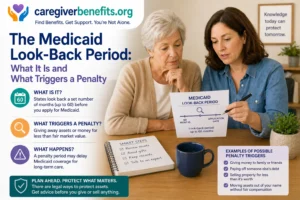
If the person may need Medicaid long-term care, ask your state Medicaid office or an elder law attorney before paying family. Medicaid can review transfers made during the 60-month look-back period when someone applies for long-term care coverage. CMS explains that states look for transfers made for less than fair market value when a person applies for Medicaid long-term care. CMS transfer-of-assets backgrounder
Important: A caregiver agreement does not make every payment safe. State Medicaid rules can differ. Tax rules can differ. Some public programs have their own care plan, rate, worker rules, and payroll system.
Who this helps
This guide helps families who want to pay a relative for care at home.
It may help if:
- An adult child is leaving work hours to care for a parent.
- A spouse is paying another family member for daily help.
- Siblings agree one person is doing most of the work.
- A parent has savings and wants to pay for help at home.
- The family may need Medicaid nursing home care or Medicaid home care later.
- The family wants to avoid fights about money and care tasks.
This guide is not a blank legal form. A real agreement should fit your state, the person’s care needs, the caregiver’s work, and the tax setup.
What a caregiver agreement is
A caregiver agreement is also called a personal care agreement, personal services contract, elder care contract, or family caregiver contract.
It is a written deal between the person who needs care and the person who gives care.
It should answer these basic questions:
- Who is receiving care?
- Who is giving care?
- What tasks will the caregiver do?
- Where will care happen?
- When does the agreement start?
- How many hours can be paid?
- What is the hourly or daily rate?
- How will payment be made?
- What records must be kept?
- How can the agreement end?
Why informal family payments can cause Medicaid problems
Many families pay with cash, checks, or bank transfers and call it helping out. That may feel normal. But it can create a record problem later.
When someone applies for Medicaid long-term care, the state may review transfers, gifts, and payments made during the look-back period. CMS says the look-back period for Medicaid long-term care is 60 months, or five years. CMS transfer-of-assets backgrounder
If the state thinks money was given away for less than fair market value, it may set a penalty period. During a penalty period, Medicaid may not pay for long-term care services. Pennsylvania’s Medicaid long-term care page gives a clear state example. It says transfers within 60 months are reviewed, and if fair market value was not received, a penalty period may apply. Pennsylvania DHS long-term care Medicaid transfer rules
A written caregiver agreement and good records can help show that payments were for real services, not gifts. But each state can decide what proof it needs.
What may pay or help
A caregiver agreement is not the same thing as a benefit. It is a private contract. It can be used when the care receiver pays from their own money. It may also support records if a public program or private policy allows paid family care.
| Path | What it may do | What to check first |
|---|---|---|
| Private pay from the person who needs care | The older adult or disabled person pays a family caregiver from their own funds. | Check Medicaid transfer rules, tax rules, legal authority, and fair market value before the first payment. |
| Medicaid self-directed or HCBS programs | Some state Medicaid programs allow a person to choose a family member or friend as a paid caregiver. | Rules, allowed relatives, rates, worker checks, and payroll setup vary by state. Start with your state Medicaid office. USAGov caregiver pay overview |
| Medicare home health | Medicare may cover certain part-time or intermittent skilled home health services when the person meets the rules. | Medicare does not pay for 24-hour home care, meal delivery, homemaker services unrelated to the care plan, or personal care when that is the only care needed. Medicare.gov home health coverage |
| VA benefits | VA Aid and Attendance may add money to a VA pension for a qualified veteran or survivor who needs help with daily activities. VA PCAFC is a separate caregiver program for eligible veterans and caregivers. | Check VA rules before assuming a family caregiver can be paid. VA Aid and Attendance and VA PCAFC |
| Long-term care insurance | Some policies may pay for home care. Some may allow family caregivers. Others may not. | Ask the insurer for written benefit rules before care starts. |
| Local aging programs and respite | Area Agencies on Aging may know about respite, caregiver support, adult day care, meals, and local help. | Use the Eldercare Locator to find local aging services. ACL Eldercare Locator |
If your main goal is to find a program that may pay you as a caregiver, also read Can I Get Paid to Be a Caregiver?. If you need a break from care duties, read Respite Care for Caregivers.
Who may qualify to use a caregiver agreement
A caregiver agreement may work when the person receiving care has the legal ability to sign a contract and pay for care.
If the person cannot sign or understand the agreement, someone else may need legal authority. This could be a power of attorney, guardian, or conservator. The exact rule depends on your state and the legal document. For more on this topic, read Power of Attorney for an Aging Parent.
The caregiver must be allowed to be paid
A private family agreement may allow payment to an adult child, relative, friend, or other helper. But Medicaid and other public programs may have stricter rules.
For example, Georgia Medicaid’s personal care contract policy says a personal care contract must be specific and verifiable, services must be at market rate, payment must be supported by proof, and a contract that fails required terms may be invalid for Medicaid eligibility. The same Georgia policy says the caregiver cannot be the spouse or parent of the applicant or recipient. Georgia Medicaid personal care contract policy
That does not mean every state uses Georgia’s rule. It means you must check your own state before paying a spouse, parent, adult child, or other relative.
Where to start first
Do this before money changes hands:
- Write down who needs care, what help they need, and how often they need it.
- List the exact duties the family caregiver will do.
- Ask whether Medicaid long-term care may be needed within the next five years.
- Call your state Medicaid office or local aging office and ask how caregiver agreements are reviewed.
- Ask an elder law attorney before using a large lump sum, prepayment, back payment, house transfer, or payment to a spouse.
- Check IRS household employee rules before paying wages.
- Use checks, direct deposit, or bank transfer. Do not use cash if you need a clear record.
Families often wait until a crisis. They write a quick agreement after money has already moved. That is risky.
Indiana’s Medicaid policy gives one official example of how strict records can be. It says agreements and logs must show services, dates and hours, caregiver names, fair market value proof, payment proof, and total amount paid to each caregiver. It also says missing or unclear information may result in a transfer penalty. Indiana FSSA personal care agreement policy
What to include in a caregiver agreement
Use clear words. Do not use vague phrases like help Mom. Medicaid, siblings, tax preparers, and courts may need to see what was paid for.
1. Names and relationship
List the person receiving care, the caregiver, and any person signing under power of attorney or guardianship.
2. Start date
State when paid care begins. Do not backdate the agreement.
3. Care duties
List real tasks. Examples include bathing help, dressing help, transfers, meal prep, medication reminders, rides to medical visits, laundry tied to care, and safety checks.
4. Hours and schedule
State the normal schedule and the maximum paid hours per week or month.
5. Rate of pay
Use a fair market rate. Keep proof of how you chose it, such as local home care agency rates or state program rates if allowed.
6. Payment method
State how often payment will be made. Use a record-friendly method, such as check or bank transfer.
7. Records
Require time sheets, care logs, invoices, receipts, and payment records.
8. Taxes and payroll
State that the family will follow tax and payroll rules and ask a tax professional when needed.
9. Ending the agreement
Explain when payment stops, such as hospital admission, nursing home move, death, or written notice.
Fair market value means the rate must make sense
Fair market value means the pay should be close to what similar care would cost in the local area. It should match the type of work, skill level, schedule, and care needs.
Do not pay a family member a high rate just to move money out of the older adult’s account. That can look like a gift. Texas Medicaid defines fair market value for resources as the going price in the local market. Texas HHS fair market value policy
For care work, good proof may include written quotes from local licensed home care agencies, published local care rates, or state Medicaid rate information if your state uses it for review. Ask your state Medicaid office what proof it accepts.
Tax and payroll warnings
Paying a family caregiver can create tax duties for both sides.
IRS Publication 926 helps households decide whether a worker is a household employee and whether federal employment taxes are owed. IRS Publication 926
The IRS also says family caregiver situations can differ. A caregiver may need to report pay as income. In some cases, the caregiver may be an employee. In other cases, the caregiver may not be an employee and may need to consider self-employment tax. IRS family caregivers and self-employment tax
The U.S. Department of Labor says some Medicaid-funded and public home care programs allow a person to select a family or household member as a paid care provider. It also says the care plan usually describes the paid services and hours after an assessment. Department of Labor Fact Sheet 79F
Do not guess on payroll. Ask a CPA, enrolled agent, payroll service, or tax clinic before payments begin. State payroll, workers’ compensation, paid leave, and unemployment rules may also apply.
What documents may be needed
Keep these in one folder:
- Signed caregiver agreement.
- Power of attorney, guardianship papers, or conservatorship papers if someone else signs.
- Doctor note, discharge plan, care plan, or assessment showing why help is needed.
- List of care duties.
- Local rate proof, such as agency quotes or other local wage proof.
- Daily or weekly care logs.
- Timesheets with dates, hours, and tasks.
- Invoices or payment requests from the caregiver.
- Bank records, canceled checks, or direct deposit records.
- Tax forms and payroll records.
- Receipts for supplies, mileage, or care-related costs if reimbursed.
- Notes from calls with Medicaid, VA, insurers, or local aging offices.
- Letters, notices, or denials from Medicaid or other programs.
How to check your state rules
This is a national starting point. Caregiver agreements depend heavily on state rules.
Start with the state where the person receiving care lives. Ask that state’s Medicaid agency how it treats private family caregiver agreements if the person later applies for Medicaid long-term care or HCBS.
Ask these questions:
- Does the state review private caregiver agreements during Medicaid long-term care applications?
- Must the agreement be signed before payment starts?
- Must it be notarized?
- Are lump-sum payments allowed?
- Can a spouse be paid?
- Can an adult child be paid?
- What proof of fair market value is accepted?
- What logs and payment records are required?
- Does the state have a consumer-directed Medicaid program?
- Does the person need a care needs assessment first?
For Medicaid-paid care, the route is different from a private agreement. Medicaid home and community-based services can allow people to receive services in their own home or community instead of an institution, but programs and target groups vary. Medicaid.gov HCBS overview
CMS also describes Medicaid personal care services as services that help eligible people stay in their homes and communities instead of institutions. CMS personal care services
To find local aging help, use the ACL Eldercare Locator or HHS state aging resources. HHS resources near you
What usually goes wrong
- Paying before the agreement is signed. Payments made first can be hard to prove later.
- Backdating the agreement. This can hurt trust and may not work for Medicaid review.
- Using cash. Cash makes records harder.
- Paying a lump sum for past care. Some states may treat this as a transfer problem.
- No care logs. A check alone may not prove what services were given.
- No fair market value proof. Medicaid may ask why the rate was chosen.
- Mixing family chores with paid care. Be clear about what is paid and what is unpaid family help.
- No tax plan. The caregiver may have income to report. The payer may have payroll duties.
- No legal authority. A family member may not be able to sign for the older adult without valid authority.
- Siblings are surprised later. Secret payments can turn into family fights, probate fights, or abuse claims.
Sibling disputes are common
A caregiver agreement can reduce fights. It can also create fights if other family members learn about it late.
When safe and appropriate, share the plan before payments begin. Show the care duties, hours, rate, and payment records. Keep emotion out of the accounting.
If the family is already fighting, ask an elder law attorney before signing. In some families, a neutral care manager, mediator, or attorney meeting may save bigger problems later.
What to do if the first path does not work
If your first answer is no, ask why in writing. Do not stop there.
- If Medicaid questions past payments: ask for the exact reason. Submit the signed agreement, time logs, rate proof, payment proof, and care records.
- If Medicaid says there is a transfer penalty: read the notice. Ask about fair hearing rights, deadlines, and hardship rules. Talk to an elder law attorney fast.
- If a Medicaid program will not pay the chosen family member: ask whether another program, waiver, adult day care, respite, or agency care is available.
- If taxes are unclear: pause new payments until a CPA, enrolled agent, payroll service, or tax clinic gives written guidance.
- If siblings object: share records. Offer a meeting with the attorney or care manager. Do not hide payments.
- If the person needs more care than one family member can safely give: ask about Medicaid HCBS waivers, respite, adult day care, home health, VA benefits, or long-term care placement options.
For help comparing care costs, use the Care Cost Calculator. For practical forms and family task lists, see Caregiver Checklists. For more call wording, see Phone Scripts.
Phone script: what to ask before paying a family caregiver
Call your state Medicaid long-term care office or local aging office:
Hello. I care for a family member who may need Medicaid long-term care or home care in the future. The family is thinking about a written caregiver agreement to pay a relative for care at home. Can you tell me how your state reviews these agreements?
What must be in the agreement? Does it need to be signed before payment starts? Does it need to be notarized? What records should we keep for hours, duties, payments, and fair market value?
Can you send me the policy page or tell me where to find it online?
Tip: Write down the date, time, phone number, name of the person you spoke with, and what they said. Ask for a policy link. Phone advice can be wrong or incomplete.
When to ask an elder law attorney
Ask an elder law attorney before signing or paying if any of these are true:
- The person may need Medicaid nursing home care soon.
- The person may need Medicaid HCBS waiver care soon.
- The family wants to pay for past care.
- The family wants to pay a large lump sum.
- The caregiver will live in the home.
- The agreement involves a house, car, or property transfer.
- The person receiving care has dementia or unclear decision-making ability.
- A power of attorney is signing.
- Siblings disagree.
- The family is worried about financial abuse claims.
- The family is unsure about taxes or payroll.
An attorney can also tell you if the caregiver agreement should be notarized, witnessed, court-approved, or written in a special way for your state.
Official sources used and what we checked for this update
For this May 2026 update, we checked these official sources:
- CMS transfer-of-assets backgrounder for the Medicaid long-term care look-back and fair market value review.
- Medicaid.gov HCBS overview for home and community-based services.
- CMS personal care services for Medicaid personal care service context.
- Pennsylvania DHS long-term care Medicaid page for a state example of transfer review and penalty language.
- Georgia Medicaid personal care contract policy for a state example of personal care contract requirements.
- Indiana FSSA personal care agreement policy for a state example of logs, payments, and fair market value proof.
- Texas HHS fair market value policy for a state definition of fair market value.
- IRS Publication 926 and IRS family caregiver tax guidance for household employee and caregiver income issues.
- Department of Labor Fact Sheet 79F for paid family or household members in certain Medicaid-funded and public programs.
- Medicare.gov home health services for what Medicare does and does not cover at home.
- VA Aid and Attendance and VA PCAFC for VA benefit paths.
- ACL Eldercare Locator and HHS resources near you for local aging service routing.
We used state examples to show how rules can differ. Your state may use different terms or require different proof.
Resumen en español
Un acuerdo de cuidador es un contrato escrito para pagar a un familiar por cuidados en casa.
Debe decir que tareas hara el cuidador, cuantas horas trabajara, cuanto se pagara, cuando empieza el pago y que documentos se guardaran.
No pague primero y haga el contrato despues. Si la persona puede necesitar Medicaid para cuidado a largo plazo, hable con la oficina estatal de Medicaid o con un abogado de leyes de adultos mayores antes de pagar.
Guarde registros de horas, tareas, pagos, impuestos y la razon por la que la tarifa es justa.
About This Guide
CaregiverBenefits.org writes benefit and rights guides for family caregivers. This page focuses on paying a family caregiver with records that may matter for Medicaid, taxes, and family disputes.
This guide is a starting point. It does not replace advice from your state Medicaid office, a tax professional, or an elder law attorney.
Plain disclaimer
Rules can change. Medicaid, VA, tax, payroll, labor, and state contract rules can vary. Always confirm details with the official agency, your state Medicaid office, a qualified tax professional, or an elder law attorney before paying a family caregiver.
FAQ
Can I pay my adult child to care for me?
Maybe. A private caregiver agreement may allow this if you have legal capacity and use a fair rate with good records. If Medicaid may be needed, check your state rules before paying.
Can a spouse be paid as a caregiver?
It depends. Some private families do this, but Medicaid and public programs may limit or ban spouse payments. Check your state Medicaid rules first.
Does a caregiver agreement protect Medicaid eligibility?
It can help, but it is not a guarantee. Medicaid may still review the agreement, rate, dates, payments, and care logs.
Can we pay for care that was already given?
This is risky. Some states may treat back payments or lump sums as transfers. Ask an elder law attorney before paying for past care.
What is fair market value for family caregiving?
It means the pay should match what similar care would cost in your local area. Keep proof, such as agency quotes or other local rate records.
Does the caregiver have to report the money as income?
Often yes. The caregiver may need to report pay as income. The payer may also have payroll duties. Ask a tax professional and check IRS Publication 926.
Should we use cash?
No. Use checks, direct deposit, or bank transfer. Cash is hard to prove if Medicaid, siblings, or a tax preparer asks for records later.
Does Medicare pay family caregivers?
Medicare does not pay for 24-hour home care or personal care when that is the only care needed. Medicare may cover certain part-time or intermittent home health services if the person meets the rules.
Can a power of attorney sign the caregiver agreement?
Maybe. The power of attorney document and state law must allow it. This is a good reason to ask an elder law attorney before signing.
What if Medicaid says the payment was a gift?
Ask for the reason in writing. Submit the agreement, logs, rate proof, and payment records. Ask about fair hearing rights and talk to an elder law attorney quickly.