Veteran caregiver money help
Last checked: April 23, 2026
VA Aid and Attendance is a real monthly cash benefit. It is not a separate care program by itself. It is extra money added to a basic VA pension for some wartime veterans and some surviving spouses who need regular help with daily activities.
The hard part is that this benefit has three gates at the same time: service rules, care-need rules, and money rules. If you miss any one of them, the claim can stall or get denied. The easiest first move is to work with a free VA-accredited Veterans Service Organization representative and file as early as you can.
Bottom line: You may qualify for VA Aid and Attendance if the veteran had qualifying wartime service, the household meets VA income and net worth rules, and the veteran or survivor needs regular help with daily tasks such as bathing, dressing, or eating.
Most important next step: Do not file the medical form by itself and hope for the best. Make sure the pension claim, the care-need form, and the income and asset information all line up.
- It is a monthly cash amount added to a VA pension.
- It is for wartime veterans and some survivors.
- It is means-tested, so income and net worth matter.
- It does not require total dependence in every task.
- The VA asset transfer look-back is 3 years, not 5 years like Medicaid.
- Free help is available through VA-accredited VSOs.
You usually need to pass 3 tests at the same time
1. Service
The veteran must have qualifying wartime service and must not have a dishonorable discharge. The service-length rule depends on when active duty began.
2. Care need
The veteran or survivor must need regular help with daily activities, be in a nursing home due to disability, spend much of the day in bed because of illness, or meet the severe vision rule.
3. Money
This is a pension benefit, so the household must meet VA income and net worth limits. Medical and care expenses can help reduce countable income.
For the service test, VA says the veteran must have wartime service and meet one of the minimum active-duty rules. In plain English, many older veterans qualify if they served at least 90 days with at least 1 day during wartime. For many people who began service later, the rule is at least 24 months or the full period called to active duty, again with at least 1 wartime day.
There is also a current-condition test for the underlying pension. In most cases, the veteran must be age 65 or older, permanently and totally disabled, in a nursing home for long-term care because of disability, or already getting Social Security disability or SSI.
Tip: If you are not sure whether the service dates count as wartime, do not guess. A VSO can screen this fast from the DD214.
How much VA Aid and Attendance can pay in 2026
The numbers people post online are often confusing. Some pages use old years. Some show only part of the benefit. VA publishes this benefit through pension rate tables called MAPRs. Those are the maximum yearly amounts before countable income is subtracted.
| Household type | 2026 yearly maximum | Monthly maximum before countable income |
|---|---|---|
| Veteran alone with Aid and Attendance | $29,093 | $2,424.42 |
| Veteran with 1 dependent with Aid and Attendance | $34,488 | $2,874.00 |
| Surviving spouse with no dependent with Aid and Attendance | $18,697 | $1,558.08 |
| Surviving spouse with 1 child with Aid and Attendance | $22,304 | $1,858.67 |
These are not automatic checks for everyone. Actual payment is based on the difference between the household’s maximum pension amount and its countable income.
That means two families can both qualify and still get very different monthly amounts. If the household has Social Security, retirement income, or other countable income, the payment can be lower. If the household has high unreimbursed medical or care expenses, those expenses can reduce countable income and raise the pension amount.
⚠️ Be careful with websites that promise one magic monthly number. The public VA table does not list every family situation in simple words, and many nonofficial sites mix up old rates, add-on amounts, or different VA programs.
The public 2026 VA pension table also does not list a separate line called “veteran with spouse needing care” in those exact words. In many family cases, the public line to check is “veteran with 1 dependent” plus Aid and Attendance. If your household facts are more unusual, a VSO should match you to the correct pension category before you rely on any estimate.
The money test is real, but it is not as simple as “too much in the bank”
This benefit is needs-based. For the current VA pension year, the net worth limit is $163,699. VA’s net worth rule counts assets and income for VA purposes together. But it does not count everything.
- Your primary home is generally not counted.
- Your car is generally not counted.
- Most home furnishings are generally not counted.
- Medical and care expenses you pay out of pocket can help reduce countable income.
This is why families should not self-deny too early. A household may look “over income” at first glance, but once ongoing care costs, home-care bills, assisted living fees, or other unreimbursed medical expenses are documented correctly, the claim can look very different.
What “needs help with daily tasks” really means
A lot of families wait because they think the person must be fully bedridden or completely dependent. That is not how the rule is written.
VA says Aid and Attendance may fit when the person needs another person to help with daily activities like bathing, feeding, and dressing. It may also fit if the person must stay in bed or spend a large part of the day in bed because of illness, is in a nursing home because of mental or physical limitations, or has very limited eyesight.
In real life, this often means the veteran or surviving spouse is not “fine,” even if they can still do some things alone. Maybe they can eat on their own but cannot bathe safely. Maybe they can dress slowly but cannot manage toileting, transfers, or medications without regular supervision. The issue is regular help, not perfect helplessness.
What helps the claim: a doctor, physician assistant, nurse practitioner, or clinical nurse specialist who writes clearly about what the person cannot do safely without help.
The 3-year asset-transfer rule can wreck a good claim
VA has a 3-year look-back for asset transfers. That means when VA gets the pension claim, it reviews transfers made in the 3 years before filing.
If the applicant gave assets away for less than fair market value and those assets would have pushed net worth over the limit, VA can impose a penalty period. During that penalty period, pension is not payable. The maximum penalty can be up to 5 years.
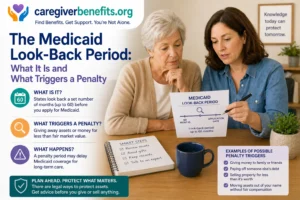
This is one reason families get into trouble when a friend says, “Just put the money in the kids’ names.” That advice can blow up a claim. It is also why VA planning and Medicaid planning are not the same thing. Medicaid’s look-back is usually 5 years. VA’s is 3 years. Different programs. Different traps.
⚠️ Do not give away money, retitle assets, or “fix” the bank accounts without advice from a qualified elder-law attorney or a very experienced accredited VSO who understands pension cases.
What this money can help pay for
This is cash paid through the pension system. VA does not assign you one agency or one caregiver. The money goes to the eligible veteran or survivor, and the household uses it to help cover care costs.
Families commonly use the benefit toward:
- Home care
- Assisted living fees
- Nursing home costs
- Other ongoing unreimbursed care and medical expenses
Some families also want to use the money to pay a relative who is providing care. That can be possible in some situations, but it needs clean documentation. Do not assume every family-pay arrangement will be treated the way you expect. If a relative is providing paid care, have a VSO review the setup before you build your budget around it.
How to apply without making this harder than it has to be
-
Screen the case first.
Have a free VA-accredited VSO check service dates, discharge, likely care-need fit, and whether the household looks close on income and net worth.
-
Use the right main claim form.
If the claimant is the veteran, the main pension form is usually VA Form 21P-527EZ. If the claimant is a surviving spouse or child, the main form is usually VA Form 21P-534EZ.
-
Add the care-need form.
For Aid and Attendance, include VA Form 21-2680. This is the exam form that explains why regular help is needed.
-
Add the facility form if needed.
If the person is in assisted living or a nursing home, include VA Form 21-0779.
-
Turn in the money proof.
Include income, net worth, and other requested financial information. If VA says you need VA Form 21P-0969, do not skip it.
-
Submit the claim in one complete package if possible.
VA says the Fully Developed Claim route is the fastest path when you send all supporting records at the start.
You can submit in several ways. You can apply online. You can upload the PDF claim form online through AccessVA QuickSubmit. You can mail a completed veteran pension claim to the VA Pension Intake Center in Janesville, Wisconsin. Or you can submit in person at a VA regional office. Most families do best when a VSO helps them choose the cleanest route and checks the packet before it goes in.
Main forms to know:
- VA Form 21P-527EZ for a veteran pension claim
- VA Form 21P-534EZ for a survivor claim
- VA Form 21-2680 for Aid and Attendance medical need
- VA Form 21-0779 if the person is in assisted living or a nursing home
- VA Form 21P-0969 if VA requires extra income and asset details
Good move: If you are filing with a PDF form instead of a fully verified online application, ask the VSO whether you should submit an intent to file first to protect the earliest possible effective date.
📞 “Hi. I’m helping a wartime veteran or surviving spouse who now needs regular help with daily tasks. We want to apply for pension-based Aid and Attendance. Can you screen eligibility, tell us which forms we need, and help us submit a complete claim?”
Do this today: Find a VA-accredited VSO and book a claim review before you gather random paperwork on your own. That one step can save weeks of back-and-forth.
Papers to gather before you start
You do not need every piece of paper in the house. But you do need the right ones.
- DD214 or other separation papers
- Basic medical evidence about the condition and daily-care limits
- Completed VA Form 21-2680
- Facility paperwork if the person lives in assisted living or a nursing home
- Income information, including Social Security, pension, retirement, or other ongoing income
- Asset information if requested
- Marriage certificate for a surviving spouse claim
- Death certificate for a survivor claim
- Private medical records related to the claim, if you have them
If the veteran’s records were destroyed years ago or the DD214 is missing, do not stop there. A VSO can still help you request or rebuild records.
What usually slows these claims down
- Sending only VA Form 21-2680. The medical form matters, but it is not the whole pension claim.
- Using the wrong main form. Veteran claims and survivor claims do not use the same core application.
- Leaving the doctor’s answers vague. “Needs help” is weaker than “needs hands-on help bathing and dressing three times a week and cannot transfer safely alone.”
- Forgetting income and asset details. This is a means-tested pension.
- Giving away assets before filing. The 3-year look-back can trigger a penalty period.
- Paying non-accredited helpers. On initial claims, VSO help is free. Stick with accredited help.
- Waiting for a crisis. VA does not promise a fixed processing time. Build in a several-month runway and apply early.
If your packet is complete at the start, the claim usually goes more smoothly. If it is thin, unclear, or missing financial detail, the family can end up answering letters for months.
If the first answer is no
A “no” does not always mean the family is done. First find out why.
- If the problem is service, ask the VSO to review wartime dates and discharge status one more time.
- If the problem is medical need, strengthen VA Form 21-2680 with clearer detail from the clinician.
- If the problem is income or net worth, make sure ongoing unreimbursed care expenses were counted correctly.
- If the problem is an asset transfer, get legal advice before moving money again.
If pension-based Aid and Attendance is not the right path, a VSO can also screen the household for other VA and non-VA routes instead of leaving you stuck.
Common questions families ask
Is Aid and Attendance the same as basic VA pension?
No. Aid and Attendance is extra money added to a basic VA pension when the veteran or survivor meets the higher care-need rule.
Can someone get Aid and Attendance and Housebound at the same time?
No. VA says you cannot receive both at the same time.
Does the person have to be completely helpless?
No. The rule is about regular help with daily activities or another listed qualifying situation. Total dependence is not the standard.
Can a surviving spouse qualify?
Yes, in some cases. The route is usually Survivors Pension plus Aid and Attendance if the survivor meets the care and money rules.
How long does it take?
VA does not give one fixed timeline for every claim. Some claims move faster than others. Plan for several months and apply as early as you can.
Do I really need a VSO?
You are not required to use one, but it is usually the smartest move. VA-accredited VSO help on initial claims is free, and it can prevent costly mistakes.
Resumen en español: La Ayuda y Asistencia de VA es dinero mensual extra que se agrega a la pensión básica de algunos veteranos de tiempo de guerra y algunos cónyuges sobrevivientes. Para calificar, normalmente se necesita servicio militar durante tiempo de guerra, necesidad regular de ayuda con actividades diarias y cumplir con límites de ingresos y bienes. No espere hasta una crisis. Pida ayuda gratis a una organización acreditada de servicio para veteranos y entregue la solicitud completa con la forma médica.
About This Guide: This page is a plain-English guide to the pension-based VA Aid and Attendance benefit for wartime veterans and some survivors. It was checked against current VA pension, rate, form, and evidence pages on April 23, 2026.
This guide is for general information only. VA rules, forms, and payment amounts can change. Always confirm details with VA or a VA-accredited representative before you file or move money around.