Florida caregiver pay guide
Last checked: May 18, 2026
Yes, some family caregivers in Florida may be paid. The most common route is not a simple state paycheck. It is usually through Florida Medicaid long-term care, a self-directed option, a state elder care subsidy, or a VA program.
The person who needs care must meet the program rules first. Then the caregiver must be approved, hired, and paid under that program’s rules.
Quick answer
A family caregiver may be paid in Florida if the person who needs care qualifies for the right program and the caregiver can be hired under that program. The main route for many adults is Florida Medicaid Statewide Medicaid Managed Care Long-Term Care, often called SMMC LTC.
Some SMMC LTC members may use the Participant Direction Option, or PDO. PDO can let the person choose and supervise a direct care worker for approved services. Florida also has Home Care for the Elderly, which may give a subsidy to help keep an older adult in a family-type home.
Do not assume that every spouse, adult child, sibling, or live-in helper can be paid. Ask the program or plan about the exact family relationship rule before you count on pay.
Start here
- Call the Florida Elder Helpline at 1-800-96-ELDER (1-800-963-5337). Ask for your local Aging and Disability Resource Center, or ADRC. Say you need screening for Medicaid long-term care and non-Medicaid elder care programs.
- Ask about SMMC LTC, Home Care for the Elderly, and Community Care for the Elderly. These are not the same program. Ask which one fits the person’s age, care needs, income, and Medicaid status.
- If the person is already in SMMC LTC, ask the plan case manager about PDO. Ask if a family member can be hired as the direct service worker for the approved services on the care plan.
Rules can change. Counties, managed care plans, waiver contractors, and agencies may use different names. Always confirm with official Florida sources before you make money or work plans.
Main Florida caregiver pay routes at a glance
| Program or route | Who it may help | Where to start |
|---|---|---|
| Florida Medicaid SMMC Long-Term Care | Adults age 18 or older who need long-term services and supports and meet Medicaid and care need rules | Call the Elder Helpline or local ADRC for screening. Apply for Medicaid through Florida DCF if needed. |
| Participant Direction Option (PDO) | SMMC LTC members who have approved PDO services on the care plan and can manage worker duties or choose a representative | Ask the SMMC LTC plan case manager, “Can we use PDO for approved personal care, homemaker, companion, or nursing services?” |
| Home Care for the Elderly (HCE) | Some Floridians age 60 or older in family-type living arrangements who may be at risk of nursing home care | Call the Elder Helpline or local ADRC and ask if HCE funding is open in your area. |
| Community Care for the Elderly (CCE) | Functionally impaired older adults who need help to stay in the least restrictive setting | Call the Elder Helpline or local ADRC and ask for CCE screening and local lead agency options. |
| APD iBudget and CDC+ | People with qualifying developmental disabilities who apply through Florida’s Agency for Persons with Disabilities | Contact a local APD office and ask about iBudget waiver services and Consumer-Directed Care Plus. |
| VA Aid and Attendance, VA PCAFC, or Veteran Directed Care | Veterans or survivors who meet VA rules, or veterans who need help at home | Contact the VA, a Florida County Veteran Service Office, or the VA Caregiver Support Line at 1-855-260-3274. |
Main ways a family caregiver may be paid in Florida
1. Florida Medicaid SMMC Long-Term Care
Florida’s main Medicaid long-term care program is Statewide Medicaid Managed Care Long-Term Care. Many people call it SMMC LTC.
This program can cover home and community-based services. These are services that may help a person stay at home or in a community setting instead of a nursing home.
Florida’s Agency for Health Care Administration, or AHCA, runs the Medicaid program and the long-term care plans. The Department of Children and Families, or DCF, decides financial Medicaid eligibility for many applicants. The Department of Elder Affairs and local ADRCs help with long-term care access and screening.
This route is often the first place to check if the person needs help with bathing, dressing, meals, transfers, toileting, light housework, or nursing care at home.
Medicaid approval is not enough by itself. The person must also meet the care need rules for long-term care services. There may also be a waiting or priority process.
2. Participant Direction Option (PDO)
PDO is the self-directed route inside Florida Medicaid long-term care plans. Self-directed means the person getting care has more say over who provides some approved services and how those services are scheduled.
Under PDO, the person may hire, train, supervise, and dismiss a direct service worker. If the person cannot manage these duties, they may choose a representative. The representative cannot be paid as the direct service worker for the same PDO services.
PDO is not for every service. AHCA materials list services such as adult companion care, homemaker services, personal care services, and certain nursing services. The service must be approved on the care plan.
This is the route most families mean when they ask, “Can Medicaid pay me to care for my parent?” The answer may be yes, but only if the person is enrolled, the service is approved, and the family caregiver meets the worker rules.
3. Home Care for the Elderly (HCE)
Florida’s Home Care for the Elderly program helps support care for people age 60 or older in family-type homes. It is meant as an alternative to nursing home care.
HCE is not the same as a regular hourly wage job. The Department of Elder Affairs says the program can provide a basic subsidy for support and maintenance of the elder. A special subsidy may also help with services or supplies.
Ask the ADRC if HCE is open in your area, whether there is a wait list, and who can be named as the caregiver. Do not assume funds are available right away.
4. Community Care for the Elderly and respite programs
Community Care for the Elderly, or CCE, can provide home and community services for some older adults. Services may include case management, personal care, homemaker help, respite, meals, transportation, and other help.
CCE usually helps pay for services. It may not pay a family caregiver directly. It can still help because it may bring in respite or in-home care so the family has less unpaid work.
Florida also lists caregiver support, RELIEF respite, and other aging programs through the Department of Elder Affairs and local Area Agencies on Aging. Ask what is open in your county.
5. APD iBudget and Consumer-Directed Care Plus
If the person has a qualifying developmental disability, check Florida’s Agency for Persons with Disabilities, or APD. APD runs access to the iBudget Florida waiver.
APD also has Consumer-Directed Care Plus, often called CDC+. CDC+ gives some iBudget waiver participants more choice and control over services. It is not the main route for most older adults. It is for people who meet APD rules.
If this may fit, contact a local APD office. Ask how to apply for APD services, iBudget waiver services, and CDC+.
6. Adult family care homes and family-type care
Florida licenses Adult Family Care Homes. These are residential homes where the provider lives in the home and gives personal care to up to five residents.
This is not the same as a family member getting paid to care for one loved one at home. It is a licensed care home model. If you are thinking about this route, ask AHCA about licensing and ask Medicaid or the long-term care plan whether any covered service can apply.
Florida does not appear to use one standard public program name called “Structured Family Caregiving” for older adult Medicaid caregiver pay. If someone uses that term, ask which Florida program they mean and which agency approves it.
7. Work leave is different from caregiver pay
Florida does not have a broad state paid family leave program for private workers that pays you to care for an older relative. Some employers offer paid leave, sick leave, or short-term leave benefits.
The federal Family and Medical Leave Act, or FMLA, may give eligible workers unpaid, job-protected leave to care for a spouse, parent, or child with a serious health condition. FMLA is not caregiver pay.
Ask your employer’s human resources office about FMLA, paid time off, sick leave, and any caregiver leave policy.
Can a spouse be paid?
Maybe, but do not assume. Florida’s public PDO materials explain the worker and representative roles, but they do not clearly list every family relationship rule on the main public page.
If you are a spouse, ask the SMMC LTC plan this exact question:
“My spouse is enrolled in, or applying for, SMMC Long-Term Care. Can a spouse be hired as the direct service worker under PDO for approved services? If yes, what forms, background checks, work rules, and limits apply?”
Also ask if the spouse can be both the representative and the paid worker. In PDO, a representative who manages employer duties cannot be paid as the direct service worker for those same PDO services.
If you get a yes, ask for it in writing or ask where it appears in the plan’s PDO materials. If you get a no, ask whether any other route may help, such as HCE, respite, VA benefits, or a non-family provider.
Can an adult child, sibling, or live-in caregiver be paid?
An adult child, sibling, other relative, friend, or live-in helper may have a better chance under a self-directed route than under standard agency care. But the program must allow it.
For SMMC LTC, ask about PDO. The caregiver may need to complete paperwork, worker agreements, background screening, training, time sheets, and tax forms through the plan or fiscal employer agent.
Living with the person does not create a paycheck. The hours must be approved. The tasks must be covered. The person must still need the service. The worker must be accepted by the program.
Ask these questions before you quit a job or cut your hours:
- Can my family relationship be paid under this program?
- Which services on the care plan can be self-directed?
- How many hours are approved?
- Who sets the pay rate?
- What background check or training is required?
- Can the caregiver live in the same home?
- Can the caregiver also be the legal representative, power of attorney, or plan representative?
What if the person is a veteran?
Check VA routes early. VA benefits can sometimes help even when Medicaid is delayed or does not fit.
VA Aid and Attendance
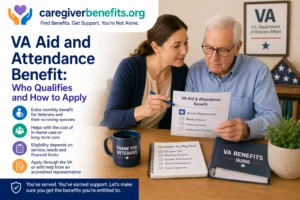
Aid and Attendance is an added VA pension amount for qualified veterans or survivors who need help with daily activities or are housebound. It is paid to the veteran or survivor, not as a normal wage to the caregiver.
The money may help pay for care costs. The VA uses forms and medical proof. VA Form 21-2680 is commonly used to apply for Aid and Attendance or housebound status.
VA PCAFC
VA PCAFC is the VA family caregiver program that may provide a stipend and other supports to an approved primary family caregiver. The veteran and caregiver must meet VA rules.
Do not assume approval. Call the VA Caregiver Support Line or ask the local VA Caregiver Support Program team how to apply.
Veteran Directed Care
Veteran Directed Care, or VDC, may let eligible veterans direct a budget for home and community care. Official ACL materials say veterans may hire workers, including family, friends, and neighbors, under an approved spending plan.
VDC is not open in the same way everywhere. Ask the veteran’s VA medical center, VA social worker, or local caregiver support team if VDC is available for the veteran.
Florida veterans can also contact a County Veteran Service Office. These offices help connect veterans and families with federal, state, and local benefits. Services are free through the Florida Department of Veterans’ Affairs network.
How to apply step by step
Step 1: Write down the care needs
List what the person needs help with each day. Include bathing, dressing, toileting, eating, walking, transfers, meals, housework, medicine reminders, wound care, memory care, and safety problems.
Write down how often help is needed. Be specific. “Needs help bathing three times a week” is stronger than “needs help at home.”
Step 2: Call the Elder Helpline or ADRC
For older adults, start with the Florida Elder Helpline at 1-800-96-ELDER. Ask for the local ADRC.
Say that you need screening for SMMC Long-Term Care. Also ask about Home Care for the Elderly, Community Care for the Elderly, respite, and caregiver support.
Step 3: Apply for Medicaid if needed
If the person is not already approved for the right Medicaid coverage, apply through Florida DCF or MyACCESS. Keep copies of the application and all proof you submit.
If income or assets may be too high, do not give money away without advice. Medicaid has look-back and transfer rules. Read our guides on Medicaid spend-down and the Medicaid look-back period.
Step 4: Complete the long-term care screening and assessment
The person may need a screening and a CARES assessment for long-term care services. CARES means the state review used to decide whether the person meets the level of care needed for Medicaid long-term care services.
Be honest about bad days. Do not describe only the best day. Tell the assessor about falls, confusion, night needs, incontinence, wandering, missed medicine, and hospital visits.
Step 5: Choose or work with the long-term care plan
If the person is approved and enrolled, they will work with a long-term care managed care plan. Ask for the case manager.
Ask what services are approved on the care plan. Then ask if any approved services can be delivered through PDO.
Step 6: Ask about caregiver hiring rules
Ask what the family caregiver must do to become a direct service worker. This may include forms, identity proof, work authorization, background screening, training, time sheets, and payroll setup.
Do not start counting unpaid care as paid work until the plan or fiscal employer agent says the worker is approved and the hours are authorized.
Step 7: Check VA and non-Medicaid routes
If the person is a veteran, call the VA Caregiver Support Line at 1-855-260-3274. Ask about PCAFC, Aid and Attendance, Veteran Directed Care, respite, and home-based services.
If the person is age 60 or older, ask the ADRC about HCE and CCE even if Medicaid is not approved yet.
What to ask on the phone
Script for the ADRC or Elder Helpline
“I care for a family member in Florida. They need help with daily care at home. I want to know if they can be screened for SMMC Long-Term Care. I also want to ask about Home Care for the Elderly, Community Care for the Elderly, respite, and any caregiver payment or subsidy programs in our county.”
Script for the SMMC LTC plan
“My family member is enrolled in your long-term care plan. I want to ask about the Participant Direction Option. Which services on the care plan can be self-directed? Can a family member be hired as the direct service worker? What are the steps, forms, background checks, and pay rules?”
Script for DCF
“I need to check Medicaid eligibility for long-term care services at home. What proof do you need for income, assets, identity, citizenship or immigration status, and medical expenses? How can I track the application and notices?”
Script for VA caregiver help
“I care for a veteran in Florida. I want to ask about PCAFC, Aid and Attendance, Veteran Directed Care, respite, and help at home. Can you connect me with the local caregiver support team or VA social worker?”
Documents to gather
You may not need every item for every program. Gather what you can before calls and applications.
- Photo ID for the person who needs care
- Social Security number
- Medicare and Medicaid cards, if any
- Health insurance cards
- Proof of Florida address
- Birth certificate, passport, or immigration papers if requested
- Bank statements and proof of assets
- Income proof, such as Social Security, pension, pay, or annuity letters
- Mortgage, rent, utility, and care cost records
- Doctor notes, hospital discharge papers, and diagnosis list
- Medication list
- List of daily care needs and safety risks
- Power of attorney, health care surrogate, guardianship, or representative papers, if any
- VA discharge papers, VA rating letters, or pension papers, if the person is a veteran
- Denial letters, notices, or plan letters if you are appealing
For more help, use our caregiver checklists and phone scripts.
If you are told no
A “no” can mean many things. It may mean the person does not qualify. It may also mean you called the wrong office, asked for the wrong program name, or missed a form.
Ask why
Ask for the reason in writing. Ask which rule or program limit caused the denial. Ask if the person can be screened for a different program.
If Medicaid is denied
Read the DCF notice. Look for the reason, appeal rights, and deadline. If the problem is missing proof, ask how to submit it. If the problem is income, assets, or transfers, consider talking with a Florida elder law attorney or benefits counselor.
If SMMC LTC services are too low
Ask the plan case manager for a reassessment. Explain what changed. Share doctor notes, fall records, hospital papers, and a daily care log.
If PDO is denied
Ask whether the service is on the care plan. Ask whether the family worker failed a worker rule or whether the plan does not allow that family role. Ask what would make the person eligible later.
If a VA caregiver claim is denied
Ask the VA about review and appeal options. Keep copies of all VA letters. You can also ask a County Veteran Service Office or accredited representative for help.
Related guides: Can I get paid to be a caregiver?, caregiver pay quiz, Medicaid HCBS waivers explained, VA Aid and Attendance, respite care, care cost calculator, caregiver tax deductions.
Common reasons for delay
- The person has not applied for Medicaid financial eligibility through DCF.
- The person was screened but is waiting for long-term care enrollment.
- The care need is not well documented.
- The doctor’s records do not show the daily help needed at home.
- The service is not on the SMMC LTC care plan.
- The family caregiver has not completed worker paperwork or background screening.
- The person wants pay for tasks that the program does not cover.
- The caller asked for “caregiver pay” instead of asking for SMMC LTC, PDO, HCE, CCE, or VA caregiver benefits.
FAQ
Does Florida pay all family caregivers?
No. Florida does not have one simple program that pays every family caregiver. Payment depends on the person’s program, care needs, Medicaid or VA status, and worker rules.
What is the best first call in Florida?
For an older adult, call the Florida Elder Helpline at 1-800-96-ELDER (1-800-963-5337). Ask for your local ADRC and SMMC Long-Term Care screening. If the person is a veteran, also call the VA Caregiver Support Line at 1-855-260-3274.
Can Medicaid pay me to care for my parent in Florida?
It may be possible if your parent qualifies for SMMC LTC, has approved services, and can use PDO. The plan must approve the service and the worker setup.
Can I be paid if I live with the person?
Maybe. Living in the home does not block every route, but it does not guarantee payment. Ask the plan or program whether a live-in family worker can be paid for the approved services.
Is Home Care for the Elderly the same as hourly caregiver pay?
No. HCE can provide a subsidy to support care in a family-type living arrangement. Ask the ADRC how payment works in your county and whether funding is open.
Can a veteran choose a family member as a paid caregiver?
Sometimes. VA PCAFC may provide a stipend to an approved family caregiver. Veteran Directed Care may allow eligible veterans to hire family, friends, or neighbors under an approved plan. Ask the VA what is available for the veteran.
Resumen en español
En Florida, algunos cuidadores familiares pueden recibir pago, pero no hay un cheque automático para todos. Las rutas principales son Medicaid de cuidado a largo plazo, la opción PDO, Home Care for the Elderly, programas de APD para discapacidades del desarrollo y beneficios del VA para veteranos.
Llame a la línea Elder Helpline al 1-800-96-ELDER (1-800-963-5337) y pida hablar con el ADRC local. Si la persona es veterana, llame también a la línea de apoyo para cuidadores del VA al 1-855-260-3274.
About this guide
This guide was written for Florida family caregivers who need a real starting point for caregiver pay, Medicaid long-term care, VA benefits, and local elder care programs. It uses official Florida and federal sources first.
Official sources used
- Florida Agency for Health Care Administration: Statewide Medicaid Managed Care Long-Term Care Program
- Florida AHCA: Find Out About Long-Term Care Services
- Florida AHCA: Participant Direction Option for Long-Term Care Plans
- Florida Department of Children and Families: Medicaid
- Florida DCF: Applying for Assistance
- Florida Department of Elder Affairs: Aging and Disability Resource Centers
- Florida Department of Elder Affairs: Contact and Elder Helpline
- Florida Department of Elder Affairs: Home Care for the Elderly
- Florida Department of Elder Affairs: Community Care for the Elderly
- Florida Department of Elder Affairs: Caregiving
- Florida Agency for Persons with Disabilities: iBudget Florida Waiver
- Florida APD: Consumer-Directed Care Plus
- Florida APD: Apply for Services
- Florida AHCA: Adult Family Care Home
- VA: Aid and Attendance Benefits and Housebound Allowance
- VA: Form 21-2680
- VA: Family Caregiver Assistance Program
- VA: National Caregiver Support Line
- VA: Veteran Directed Care
- Administration for Community Living: Veteran Directed Care
- Florida Department of Veterans’ Affairs: Benefits and Services
- U.S. Department of Labor: FMLA for Family Caregivers
Disclaimer
This is general information, not legal, tax, medical, or financial advice. For legal or tax questions, talk with a qualified professional in your state. Program rules can change, and local offices or plans should confirm details for your case.