Money & Benefits
Last checked: May 2026
Yes, a spouse may be able to get paid as a caregiver. But there is no single national spouse caregiver paycheck.
The answer depends on your state, the care receiver’s needs, income and assets, veteran status, job benefits, and the exact program rules.
This guide shows where to start, what to ask, what papers to gather, and what to do if the first answer is no.
Quick answer: sometimes, but the program matters
A spouse can sometimes be paid for care. The most common paths are Medicaid self-directed care, the VA caregiver program for certain veterans, state paid family leave, employer paid leave, or a private caregiver agreement.
Medicaid is often the first place to check when the person needs daily help at home and may meet income, asset, and care-need rules. Medicaid.gov says self-directed services can let a person recruit, hire, train, and supervise the people who provide care. But each state decides the program rules, and some programs limit or ban spouse payment. Start with your state Medicaid agency and ask about self-directed personal care, consumer-directed care, participant-directed care, and HCBS waivers.
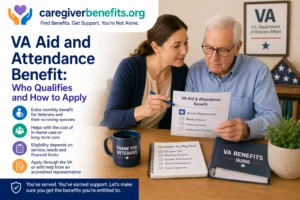
If the person is a veteran, check VA caregiver benefits. VA says an eligible caregiver for the PCAFC can be a spouse, and an eligible primary caregiver may get a monthly stipend. VA Aid and Attendance is different. It adds money to a VA pension for qualified veterans or survivors who need help with daily activities. It is paid to the veteran or survivor, not as a direct spouse paycheck.
Who this helps
This guide is for a husband, wife, or legal spouse who is giving care at home and needs to know if any program can pay them.
It may also help an adult child or helper who is calling for a parent. If the caregiver is not a spouse, also read Can I Get Paid to Be a Caregiver?
This page is most useful if the person who needs care has trouble with daily tasks such as bathing, dressing, eating, toileting, moving safely, taking medicine, or being left alone safely.
What may pay or help
These are the main paths to check. The best first path depends on the household.
| Path | Can it pay a spouse? | Where to check |
|---|---|---|
| Medicaid self-directed care | Sometimes. State and program rules decide if a spouse can be hired. | Your state Medicaid agency. Medicaid.gov says you must contact your state agency to apply, check eligibility, and get state help. |
| Medicaid HCBS waiver or state plan personal care | Sometimes. Some programs allow family caregivers. Some do not allow spouses. | Your state Medicaid long-term care or waiver office. Medicaid.gov says nearly all states and DC offer HCBS waivers, and states set target groups and other rules. |
| VA PCAFC | Yes, if both the veteran and caregiver qualify. VA says a spouse may be an eligible family caregiver. | VA Caregiver Support Program or 1-855-260-3274. |
| VA Aid and Attendance | Not a direct spouse paycheck. It may increase a VA pension for a qualified veteran or survivor who needs help. | VA.gov Aid and Attendance page or a VA-accredited representative. |
| Paid family leave | Sometimes. It can replace part of your wages while you take time off to care for a spouse, but only where your state or employer offers it. | Your state paid leave office, state labor department, or employer HR. |
| Private caregiver agreement | Sometimes, if the spouse is paid from private funds and the agreement is real, clear, and tax-safe. | An elder law attorney or tax professional before payments start. |
Medicaid spouse caregiver rules: ask the state, not a general helpline
Medicaid is partly federal and partly state-run. That is why spouse payment rules change by state and by program.
On the federal side, Medicaid.gov explains that self-directed services let some Medicaid members have more control over who provides care and how services are provided. It also lists self-direction options under state plan and waiver authorities, such as 1915(i), 1915(j), 1915(k), and 1915(c) HCBS waivers. See Medicaid.gov on self-directed services.
But that federal page does not mean every spouse can be paid in every state. Your state may have one program that allows spouse caregivers and another program that does not. The care receiver may also need a care assessment, a service plan, Medicaid long-term care approval, and a fiscal employer agent or agency to process payroll.
If Medicaid is new to your family, read Medicaid HCBS Waivers Explained and Medicaid Spend Down before you apply.
Use the words your state may use
Do not only ask, “Can my spouse get paid?” The worker may say no before checking the right program.
Ask about these names too: self-directed care, consumer-directed care, participant-directed care, personal care attendant services, in-home supportive services, Community First Choice, HCBS waiver, and family caregiver pay.
Questions to ask your state Medicaid office
- Does this state have any Medicaid program that allows a spouse to be paid as a caregiver?
- Is the program under a waiver, state plan personal care, Community First Choice, or managed long-term care?
- What is the name of the exact program?
- Can a legal spouse be hired, or only another family member?
- Does the care receiver need nursing home level of care?
- Is there a waiting list?
- Who does the in-home assessment?
- Who handles payroll and taxes?
- Can the spouse be paid if the care receiver is in a Medicaid managed care plan?
- If the answer is no, is there a different waiver or program that allows spouse caregivers?
VA paths if your spouse is a veteran or survivor
If your spouse is a veteran, do not stop at Medicaid. VA benefits may help too.
VA caregiver stipend path
The VA PCAFC, often called PCAFC, may help if the veteran and caregiver meet VA rules.
VA says a caregiver must be at least 18 and can be the veteran’s spouse, son, daughter, parent, stepfamily member, extended family member, or someone who lives full time with the veteran or is willing to do so. VA also says the veteran generally must have a VA disability rating of 70% or higher, need at least six months of continuous in-person personal care services, and be enrolled in VA health care.
An eligible primary caregiver may receive a monthly stipend, training, counseling, certain travel benefits, and respite. Start at the VA page for the PCAFC.
VA Aid and Attendance path
VA Aid and Attendance is not the same as PCAFC. It does not hire the spouse as a caregiver.
VA says Aid and Attendance can add monthly payments to a VA pension for qualified veterans and survivors who need help with daily activities, are in a nursing home due to loss of mental or physical abilities, are bedbound, or meet certain eyesight rules.
Start at VA.gov on Aid and Attendance and Housebound benefits. You can also read our guide to VA Aid and Attendance.
⚠️ Do not mix up the VA programs
PCAFC may pay an approved primary family caregiver directly. Aid and Attendance adds money to a VA pension if the veteran or survivor qualifies. The money can help pay for care, but it is not the same as being hired by VA as a spouse caregiver.
Paid family leave may help if you still have a job
If you are working and need time off to care for your spouse, check paid leave and job-protected leave.
The U.S. Department of Labor says there is no federal law that guarantees paid family and medical leave for private-sector workers. Some states have their own paid leave programs and rules. See the DOL page on paid leave.
The federal Family and Medical Leave Act may protect unpaid leave for some workers who need time off to care for a spouse with a serious health condition. DOL says eligible workers may take up to 12 workweeks of FMLA leave in a 12-month period for certain reasons, including care for a spouse with a serious health condition. See DOL Fact Sheet #28P.
Ask your employer HR office three things:
- Do I qualify for FMLA or state family leave?
- Is any part of the leave paid?
- Can I use sick time, PTO, short-term leave, or a caregiver leave benefit at the same time?
A private caregiver agreement has limits
A private caregiver agreement means the person who needs care pays the spouse from private funds. This is not a government benefit by itself.
This may sound simple, but spouse agreements can create tax, Medicaid, estate, and family problems if done badly.
Before money changes hands, ask an elder law attorney or tax professional about:
- whether a spouse caregiver agreement is valid in your state;
- whether payment could affect Medicaid now or later;
- how to set a fair rate;
- how to keep timesheets and proof of work;
- whether wages need a W-2 or other tax reporting;
- whether a power of attorney can sign the agreement.
The IRS says caregivers are often employees of the person they care for when they work in that person’s home and the person has the right to tell them what needs to be done. The IRS also says family members may or may not provide these services, and spouse caregiver payments can have special employment tax rules. See the IRS page on family caregivers and self-employment tax and IRS Publication 926.
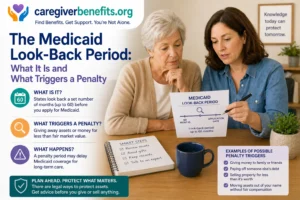
If Medicaid may be needed later, do not guess. Payments that look like gifts, back pay, or unclear transfers can cause problems. Read The Medicaid Look-Back Period and get local advice first.
What does not count as spouse caregiver pay
Do not count these as a spouse caregiver paycheck
- Medicare: Medicare may cover certain home health services if the person qualifies, but Medicare does not pay a spouse to provide long-term personal care. Medicare.gov says Medicare does not pay for 24-hour care at home, home meal delivery, homemaker services not tied to the care plan, or custodial or personal care when that is the only care needed. See Medicare home health coverage.
- Long-term care under Medicare: Medicare.gov says Medicare does not pay for long-term care and that most long-term care helps with daily personal tasks. See Medicare long-term care coverage.
- Social Security: Social Security retirement or disability benefits are paid to the eligible person. They are not a caregiver wage program.
- Power of attorney: A power of attorney may let someone act for another person, but it does not by itself create caregiver pay. Learn more at Power of Attorney for an Aging Parent.
- Being married: Marriage alone does not make a person eligible for a government caregiver payment.
- Unpaid FMLA: FMLA may protect a job for some workers, but it is not always paid. Check state and employer rules.
Where to start first
Start with the path that fits your household best.
- If your spouse may qualify for Medicaid long-term care: Call the state Medicaid agency and ask about self-directed personal care and HCBS waivers. Medicaid.gov has a state contact page at Where Can People Get Help With Medicaid & CHIP?
- If your spouse is a veteran: Call the VA Caregiver Support Line at 1-855-260-3274 or contact the local VA Caregiver Support Program team. VA lists this number on its caregiver support pages.
- If you are employed: Ask HR about state paid leave, employer caregiver leave, PTO, sick leave, and FMLA.
- If you need local help choosing a path: Contact the Eldercare Locator. ACL says the Eldercare Locator connects older adults and families to local services. You can call 1-800-677-1116 or use eldercare.acl.gov.
- If you are paying privately: Get legal and tax advice before setting up spouse caregiver pay.
You can also use our Can I Get Paid Quiz to sort the likely paths before you call.
☎️ Short phone script for calling Medicaid
“Hi, I care for my spouse at home. My spouse needs help with daily care, and we want to know if our state has any Medicaid program that can pay a spouse caregiver. Can you tell me the name of the self-directed personal care or HCBS waiver program that handles this?”
“If a spouse cannot be paid under that program, is there any other Medicaid long-term care program in this state that allows spouse caregivers?”
“Who does the care assessment, and what papers should I gather before applying?”
If the person gives a quick “no,” ask for the name of the program they checked. Write it down. Then ask if there is a waiver office, managed long-term care plan, Area Agency on Aging, or case manager who handles self-directed services.
For more scripts, see Caregiver Phone Scripts.
📄 Documents you may need
You may not need every paper for every path. But these are common documents to gather before you call or apply.
- Care receiver’s full legal name, date of birth, address, phone number, and Social Security number.
- Medicare card, Medicaid card, VA card, insurance cards, and managed care plan card.
- Proof of marriage if the program needs it.
- Doctor list, medicine list, diagnoses, and recent hospital or rehab discharge papers.
- A short list of daily tasks the person cannot do alone.
- Notes about falls, wandering, unsafe cooking, missed medicine, incontinence, or supervision needs.
- Income proof, bank statements, pension statements, Social Security award letter, and other financial papers if applying for Medicaid.
- VA disability rating information and VA health care enrollment details if applying for VA caregiver help.
- Employer leave forms if using FMLA, state paid leave, or job benefits.
- Power of attorney or legal authority papers if someone else is applying or speaking for the care receiver.
- Timesheets or care logs if setting up a private caregiver agreement or if the program asks for proof of care.
Print our caregiver checklists if you need a simple way to track care tasks before the assessment.
Who may qualify
Each path has its own rules. In general, programs look at two people: the person who needs care and the spouse who gives care.
The person who needs care may need to show:
- a need for help with daily activities;
- a need for supervision for safety;
- a medical condition, disability, or long-term care need;
- Medicaid financial eligibility, if using Medicaid;
- veteran status, VA health care enrollment, VA disability rating, pension status, or survivor status, if using VA benefits;
- state residency and program-specific rules.
The spouse caregiver may need to show:
- age and identity;
- relationship to the care receiver;
- ability to do the approved care tasks;
- training, background check, or enrollment steps if required;
- availability to provide care during approved hours;
- tax and payroll forms if the program hires the spouse.
What usually goes wrong
- The family asks the wrong question. “Can I get paid?” may get a fast no. Ask for the exact self-directed care and waiver programs.
- The spouse is allowed under one program but not another. State rules can split programs in ways that are hard to see from the outside.
- The care need is not documented. A doctor note alone may not be enough. Keep a care log that shows daily help and safety risks.
- The family expects back pay. Most programs do not pay for months of care given before approval.
- The care receiver is over income or asset limits. Medicaid long-term care rules can be strict. Do not move money or give assets away without advice.
- The family mixes up Medicare and Medicaid. Medicare is health insurance. Medicaid may cover long-term services for people who qualify.
- The VA path is the wrong one. PCAFC, Aid and Attendance, and other VA supports have different rules.
- Private pay is not documented. Cash payments with no agreement, no timesheets, and no tax plan can cause trouble later.
What to do if the first path does not work
A first no does not always mean there is no help. It may mean that one program does not fit.
- Ask for the denial or answer in writing when possible.
- Write down the program name, worker name, date, and reason for the no.
- Ask if another waiver, managed care plan, or state plan service allows spouse caregivers.
- Ask for an in-home care assessment if one has not been done.
- Call the Area Agency on Aging or Eldercare Locator for local options.
- If the person is a veteran, call VA caregiver support and ask about both PCAFC and Aid and Attendance.
- If direct spouse pay is not allowed, ask about agency home care, adult day care, respite, home-delivered meals, transportation, or home modifications.
- If you work, ask HR about paid leave, unpaid FMLA, remote work, reduced hours, or flexible scheduling.
If you are close to burnout, check Respite Care for Caregivers. Respite may not replace income, but it can give you short-term help while you work on the payment path.
Official sources used for this update
For this May 2026 update, we checked these official sources:
- Medicaid.gov self-directed services
- Medicaid.gov state Medicaid agency contact page
- Medicaid.gov HCBS 1915(c) waiver page
- VA.gov PCAFC
- VA.gov Aid and Attendance and Housebound benefits
- U.S. Department of Labor paid leave page
- U.S. Department of Labor FMLA Fact Sheet #28P
- IRS family caregivers and self-employment tax page
- IRS Publication 926, Household Employer’s Tax Guide
- Medicare.gov home health services
- Medicare.gov long-term care coverage
- ACL Eldercare Locator
Resumen en español
Un esposo o esposa a veces puede recibir pago por cuidar a su pareja, pero no hay una regla nacional única.
Primero llame a Medicaid de su estado y pregunte por cuidado autodirigido, cuidado personal, o programas HCBS. Pregunte si el programa permite pagar a un esposo o esposa.
Si su pareja es veterano, llame al programa de cuidadores de VA. El programa PCAFC puede pagar a un cuidador familiar aprobado. Aid and Attendance es diferente; puede aumentar una pensión de VA, pero no es un cheque directo al cuidador.
Si usted trabaja, pregunte a recursos humanos sobre licencia familiar pagada, FMLA, días de enfermedad, PTO, o beneficios de cuidador.
About This Guide
CaregiverBenefits.org writes benefit guides for family caregivers who need clear next steps. This guide focuses on spouse caregiver payment paths, not general caregiving tips.
We checked official federal sources first. State Medicaid rules, paid leave rules, managed care rules, and local program names can change. Use this article as a starting point, then confirm details with your state agency, VA, employer, or local aging office.
Plain disclaimer
This guide is for general information. It is not legal, tax, medical, or financial advice. Program rules can change. Always confirm details with the official agency or a qualified local professional before you apply, sign an agreement, move money, or report income.
FAQ
Can a wife get paid to care for her husband?
Sometimes. A wife may be paid if a state Medicaid self-directed program, VA caregiver program, employer benefit, state paid leave program, or private agreement allows it. The rules depend on the program.
Can a husband get paid to care for his wife?
Sometimes. The same rules apply. The key question is not gender. The key question is whether the specific program allows a legal spouse to be paid.
Does Medicaid pay spouses to be caregivers?
Medicaid may pay spouses in some states and programs. Many spouse-payment paths are tied to self-directed personal care or HCBS waiver services. You must ask your state Medicaid agency about the exact program rules.
Does Medicare pay a spouse caregiver?
No, Medicare does not pay a spouse to provide long-term personal care. Medicare may cover certain home health services if the person qualifies, but it does not pay for long-term care or custodial care when that is the only care needed.
Can VA pay a spouse caregiver?
Yes, VA PCAFC may pay an approved primary family caregiver, and VA says a spouse can be an eligible caregiver if all rules are met. VA Aid and Attendance is different. It adds money to a VA pension for qualified veterans or survivors.
What should I ask Medicaid first?
Ask: “Does this state have any Medicaid self-directed personal care, consumer-directed care, or HCBS waiver program that allows a spouse to be paid as a caregiver?” Then ask for the program name, assessment process, waiting list status, and spouse rules.
Can I get paid for care I already gave?
Usually, you should not count on back pay. Many programs only pay after approval, assessment, service planning, and caregiver enrollment. Ask the program before assuming past care can be paid.
Do I need a power of attorney to get paid as a spouse caregiver?
A power of attorney may help with applications or paperwork, but it does not by itself create a right to caregiver pay. The program must allow spouse payment, and the caregiver must meet program rules.