Medicare & Medicaid
Last checked: May 2026
Medicaid may pay for long-term nursing home care when a person meets the state’s medical and financial rules. The nursing home must also be licensed and certified for Medicaid nursing facility care.
This guide explains where to start, what papers to gather, what the family may owe, and what to do if the first answer is no.
Quick answer
Medicaid can pay for nursing home care when three things are true:
- The person needs nursing facility level care under state rules.
- The person meets Medicaid financial rules for long-term care.
- The care is in a Medicaid-certified nursing facility.
Medicare is different. Medicare usually does not pay for long-term custodial nursing home care. Medicare may pay for short-term skilled nursing care after certain hospital stays or when skilled care is medically needed. Medicare explains that most nursing home care is custodial care, and Original Medicare does not cover custodial care if that is the only care needed. See Medicare.gov nursing home care and Medicare.gov nursing home payment options.
Medicaid rules vary by state. Use this page as a starting point. Then call the state Medicaid agency and the nursing home billing office before you sign papers or move money.
Who this helps
This guide is for a family member who is trying to pay for nursing home care for a parent, spouse, relative, or friend.
It may help if:
- A hospital says your loved one needs a nursing home.
- Medicare rehab days are ending.
- The nursing home says the bill will become private pay.
- You were told to apply for long-term care Medicaid.
- You worry that a spouse at home will lose everything.
- You were asked to sign as a “responsible party.”
- The nursing home talks about discharge because Medicaid is not approved yet.
If your loved one may still be safe at home with services, also read Medicaid HCBS Waivers Explained. Home and community-based services may help some people avoid or leave a nursing home, but waiver access and waiting lists vary by state.
What may pay or help
Many families hear “nursing home” and think Medicare will pay. Often, that is not true for long-term care. The table below shows the main paths.
| Path | What it may cover | What to check first |
|---|---|---|
| Medicaid nursing facility coverage | Long-term nursing home care in a Medicaid-certified facility when the person qualifies. | Call the state Medicaid agency and ask for the long-term care Medicaid application process. Medicaid.gov says nursing facility services are provided in Medicaid-certified nursing homes. |
| Medicare skilled nursing facility care | Short-term skilled care when Medicare rules are met. It is not the same as long-term custodial care. | Ask whether the stay is Medicare-covered skilled nursing care, when coverage may end, and how to appeal if it ends too soon. |
| Long-term care insurance | Some policies pay for nursing home care. Each policy is different. | Call the insurer. Ask for the daily benefit, elimination period, covered facilities, and claim forms. |
| VA benefits | Some veterans may have VA long-term care options or pension help. Rules depend on the veteran’s status, care need, income, assets, and VA system. | Start with VA.gov or a VA-accredited representative. For pension help, see VA Aid and Attendance Benefit. |
| Private pay | The resident pays out of income and assets until another payer starts or funds run out. | Ask the nursing home for the private-pay rate in writing and whether it accepts Medicaid after spend-down. |
Who may qualify for Medicaid nursing home coverage
Medicaid nursing home coverage has both care rules and money rules.
The care need test
The state must decide that the person needs a nursing facility level of care. This often means the person needs regular help, nursing care, or supervision that cannot be safely handled in a lower level of care.
Medicaid.gov says nursing facility services include skilled nursing or medical care, rehab related to injury, disability, or illness, and long-term health-related care above room and board. It also says Medicaid nursing facility coverage is available only in a nursing home licensed and certified by the state as a Medicaid Nursing Facility. Read the federal overview at Medicaid.gov Nursing Facilities.
The money test
The person must also meet the state’s financial rules. States look at income, assets, transfers, and sometimes home equity. A person may qualify for nursing home Medicaid even if they did not qualify for other Medicaid in the past. Medicare.gov says many states have higher Medicaid income limits for nursing home residents and that eligibility varies by state.
Do not guess from a general Medicaid page. Long-term care Medicaid rules are often different from regular health coverage rules.
Other eligibility rules
The state may also check age, disability status, citizenship or immigration status, state residency, Social Security number, and cooperation with requested proof. If the person is married, the state should also review spousal protection rules.
Where to start first
- Ask the nursing home if it is Medicaid-certified. Not all nursing homes accept Medicaid. If the home is not Medicaid-certified, Medicaid nursing facility coverage may not pay there.
- Ask who handles Medicaid applications. Some homes have a Medicaid office or social worker. They may help gather forms, but the state decides eligibility.
- Contact the state Medicaid agency. Medicaid.gov says you must contact your state Medicaid agency to apply, check eligibility, track an application, or find Medicaid providers. Use Medicaid.gov’s state Medicaid contact page.
- Ask for the long-term care Medicaid application. Use those words. Do not ask only for “health insurance Medicaid.”
- Ask if a level-of-care screen is needed. The state or its contractor may need a medical assessment before approval.
- Ask what happens while the application is pending. Get the nursing home’s Medicaid-pending policy in writing if possible.
Tip: Keep a call log. Write the date, agency, person’s name, phone number, and what they said. This helps if the file is delayed or denied.
Documents you may need
Each state has its own list. The state may ask for more proof after you apply. Start with these papers if you can find them.
- Photo ID.
- Social Security card or number.
- Medicare card, Medicaid card, and other insurance cards.
- Marriage certificate, divorce decree, or spouse’s death certificate if needed.
- Power of attorney, guardianship order, or other legal authority if someone else is applying.
- Recent bank statements for all accounts.
- Statements for CDs, retirement accounts, stocks, bonds, annuities, trusts, and life insurance.
- Proof of income, such as Social Security, pension, VA benefits, wages, or rental income.
- Deeds, property tax bills, mortgage statements, and proof of home value if the person owns a home.
- Vehicle title or registration.
- Prepaid funeral or burial papers.
- Records of large gifts, transfers, or sales during the look-back period.
- Medical records that show the need for nursing facility care.
- Nursing home admission papers and current bill.
If you are missing documents, do not wait too long to apply. Ask the Medicaid worker how to submit what you have and how to send missing proof later.
What the resident may have to pay each month
Approval does not always mean the resident pays nothing.
For many nursing home residents, Medicaid uses a post-eligibility income calculation. This means the resident may have to pay most of their monthly income toward care after certain allowed deductions. Families often call this the patient pay amount, share of cost, or resident liability. The name varies by state.
Medicaid.gov says the post-eligibility calculation decides how much a person in an institution can contribute to their own care. Protected amounts may include a personal needs allowance, certain spouse or family allowances, and allowed medical expenses. After those deductions, remaining income usually goes toward the cost of care. See the Medicaid.gov page on spousal impoverishment and post-eligibility treatment of income.
Important: The personal needs allowance can be small. It is money the resident keeps for personal items. States may set their own amount above the federal minimum. Ask the nursing home and state Medicaid agency for the exact amount in your state.
Also ask how the resident will keep paying Medicare premiums, drug plan premiums, health insurance, or uncovered medical costs. If the amount looks wrong, ask for the calculation in writing.
Rules that may protect a spouse at home
If the nursing home resident is married and the spouse still lives at home or in the community, Medicaid spousal impoverishment rules may protect part of the couple’s income and resources for that spouse.
These rules do not let every couple keep everything. They are meant to help the spouse at home avoid being left with too little to live on. Medicaid.gov posts annual federal spousal standards, including 2026 standards, at Updated 2026 SSI and Spousal Impoverishment Standards.
The actual result depends on the state, the couple’s income and assets, the spouse’s own income, housing costs, and when the person entered long-term care. Ask the Medicaid worker for a spousal assessment or resource assessment if your state uses that term.
Do not move money around without advice. Transfers between spouses may be treated differently from gifts to other people, but timing and paperwork matter. A local elder law attorney or legal aid office may help if the house, spouse’s income, or large assets are involved.
Look-back, spend-down, and transfers
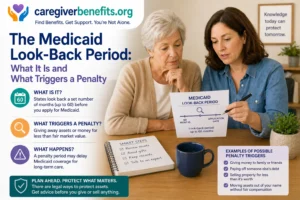
Medicaid does not only look at what the person owns today. For long-term care, states review past transfers. Federal Medicaid guidance tied to the Deficit Reduction Act describes the 60-month look-back period for transfers of assets for less than fair market value.
A transfer can mean giving away money, adding someone to a deed, selling property for less than it is worth, or moving assets in a way the state counts as a gift. If Medicaid finds a transfer that is not allowed, it may impose a penalty period. During that time, Medicaid may not pay for long-term care services even if the person otherwise qualifies.
For a plain guide, read The Medicaid Look-Back Period. If the issue is too much income or too many assets, read Medicaid Spend-Down.
Warning: Do not give away money or transfer a home just because someone said “Medicaid only lets you keep $2,000.” That advice can create a penalty. State rules, spouse rules, home rules, and exemptions matter.
What “Medicaid pending” really means
“Medicaid pending” usually means the long-term care Medicaid application has been filed but the state has not approved it yet.
Some nursing homes accept residents while Medicaid is pending. Some do not. Some require private pay until approval. Some may help with the application but still expect the resident’s income to be paid to the facility during the pending period.
Ask these questions before admission or as soon as possible:
- Do you accept Medicaid-pending residents?
- Do you accept Medicaid after private-pay funds run out?
- What happens if Medicaid is denied?
- What happens if there is a transfer penalty?
- Will you give me a written list of papers still needed?
- Who at the facility will help with Medicaid paperwork?
A pending application is not the same as approval. Keep copies of everything you submit. If the state asks for proof, answer by the deadline or ask for more time in writing.
Family member liability myths
Many adult children and spouses fear they will have to pay the nursing home bill from their own money. In many cases, a nursing home that takes Medicare or Medicaid cannot require a third party to personally guarantee payment as a condition of admission or continued stay.
The Consumer Financial Protection Bureau says nursing homes should not try to make a caregiver, family member, or friend personally responsible for a loved one’s bill as a condition of admission. It also warns families to watch for contract terms such as “responsible party” or “joint and several liability.” Read CFPB: Caregivers and nursing home debt.
This does not mean you can ignore bills or misuse the resident’s money. If you are power of attorney or guardian, you may have duties to use the resident’s funds for the resident’s care. But that is different from agreeing to pay the bill from your own savings.
Before you sign: Ask for time to read the admission agreement. Cross out nothing on your own unless a lawyer tells you to. If the form seems to make you personally liable, ask legal aid, an elder law attorney, or the long-term care ombudsman for help.
If the nursing home talks about discharge
A nursing home cannot simply put a resident out because paperwork is hard or payment is changing. Federal nursing home rules include admission, transfer, and discharge rights. The eCFR lists 42 CFR 483.15, and CMS guidance says facilities must have equal policies and practices regardless of payment source.
Discharge and transfer rules are detailed, and state appeal steps matter. In general, ask for:
- The discharge or transfer notice in writing.
- The reason for discharge.
- The appeal instructions.
- The planned safe discharge location.
- The name and number for the state long-term care ombudsman.
CMS says the Long-Term Care Ombudsman Program works to resolve problems related to the health, safety, welfare, and rights of people in long-term care facilities, including nursing homes. Use ACL’s page on the Long-Term Care Ombudsman Program to learn what the program does.
If Medicare skilled nursing coverage is ending too soon, Medicare says you may have the right to a fast appeal. See Medicare.gov fast appeals.
What usually goes wrong
- The family applies for the wrong Medicaid program. Ask for long-term care Medicaid or nursing home Medicaid.
- The nursing home is not Medicaid-certified. Ask before admission if Medicaid may be needed later.
- Bank statements are missing. Missing proof can delay or deny the case.
- Old gifts or transfers are not explained. The state may treat them as transfers for less than fair market value.
- The spouse at home is not reviewed correctly. Ask about spousal income and resource protections.
- The family assumes Medicare will keep paying. Medicare skilled care and Medicaid long-term care are different programs.
- Someone signs an admission contract too fast. Read any “responsible party” language before signing.
- The state sends a notice and no one opens it. Medicaid notices may have short deadlines. Open every letter right away.
What to do if the first path does not work
If Medicaid is denied, delayed, or does not cover the stay, do not stop at a phone answer.
- Ask for the decision in writing. You need the reason and appeal deadline.
- Ask what proof is missing. Sometimes the issue is a missing statement, not true ineligibility.
- File an appeal by the deadline. Follow the notice instructions. Keep proof that you filed.
- Ask the nursing home for a billing hold while the appeal is pending. Get any agreement in writing.
- Call the long-term care ombudsman if discharge is threatened. Ask for help with resident rights and safe discharge rules.
- Call legal aid or an elder law attorney if there is a transfer penalty, home issue, spouse issue, or debt claim against family.
- Ask about other care paths. If nursing home care is not the only safe option, ask about HCBS waivers, PACE, adult day health, or home care programs. Start with your state Medicaid agency or the Eldercare Locator.
If you are trying to keep someone safely at home, see Can I Get Paid to Be a Caregiver? and Can I Get Paid Quiz. These can help you check the right benefit paths without assuming every state pays family caregivers the same way.
Phone script for the first call
Call the state Medicaid agency or county Medicaid office:
“Hello. I am helping my [mother/father/spouse] apply for long-term care Medicaid for nursing home care. They are in, or may enter, a nursing home. Can you tell me how to apply for nursing facility Medicaid, what level-of-care screen is needed, and what documents you need? Also, can you tell me how to check if the nursing home accepts Medicaid?”
Before you hang up, ask:
- “What is the application deadline or next step?”
- “Where do I send bank statements and proof?”
- “How do I check application status?”
- “Can I get the answer or checklist in writing?”
For more scripts, see Caregiver Phone Scripts.
Official sources used for this update
For this May 2026 update, we checked these official and government sources:
- Medicaid.gov: Nursing Facilities
- Medicare.gov: Nursing home care
- Medicare.gov: How can I pay for nursing home care?
- Medicaid.gov: Spousal Impoverishment
- CMS/Medicaid.gov: Updated 2026 SSI and Spousal Impoverishment Standards
- Medicaid.gov: Estate Recovery
- Medicaid.gov: State Medicaid contacts
- ACL: Long-Term Care Ombudsman Program
- CFPB: Caregivers and nursing home debt
- eCFR: 42 CFR 483.15 Admission, transfer, and discharge rights
Resumen en español
Medicaid puede pagar cuidado en un hogar de ancianos si la persona cumple con las reglas médicas y financieras del estado. El hogar también debe aceptar Medicaid.
Medicare normalmente no paga cuidado custodial de largo plazo. Si la persona necesita cuidado a largo plazo, llame a la oficina de Medicaid de su estado y pida la solicitud para Medicaid de cuidado a largo plazo o hogar de ancianos.
Antes de firmar papeles, pregunte si usted será responsable con su propio dinero. Un hogar de ancianos normalmente no debe exigir que un familiar pague la deuda como condición de admisión.
About this guide
CaregiverBenefits.org writes benefit guides for family caregivers who need clear steps, not legal terms. This page is a national starting point. Medicaid nursing home rules are state-run, so the next step is always to confirm the rule with the state Medicaid agency, the nursing home billing office, or a qualified local adviser.
Helpful related pages:
Plain disclaimer
This guide is general information. It is not legal, financial, medical, or tax advice. Medicaid rules can change, and states apply long-term care rules in different ways. Confirm details with your state Medicaid agency, the nursing home, a legal aid office, or a qualified elder law attorney.
FAQ
Does Medicaid pay for nursing home care?
Yes, Medicaid can pay for nursing home care when the person qualifies medically and financially and receives care in a Medicaid-certified nursing facility. The state Medicaid agency decides eligibility.
Does Medicare pay for long-term nursing home care?
Usually no. Medicare may pay for skilled nursing care when Medicare rules are met, but it does not cover custodial care if that is the only care needed.
Can someone qualify for nursing home Medicaid if they never had Medicaid before?
Yes, it is possible. Medicare.gov says many states have higher Medicaid income limits for nursing home residents. Long-term care Medicaid can have different rules from regular Medicaid.
What is the patient pay amount?
It is the part of the resident’s income that must be paid toward nursing home care after Medicaid allows certain deductions. States may call it patient liability, share of cost, or another name.
Can the spouse at home keep any income or assets?
Often, yes. Medicaid spousal impoverishment rules may protect some income and resources for the spouse living in the community. The exact amount depends on state rules and the couple’s facts.
What is the Medicaid look-back period?
For long-term care Medicaid, states review transfers made during the look-back period. Gifts or transfers for less than fair market value can cause a penalty period.
Should we spend down before applying?
Do not spend or transfer money without checking the rules. Some spending is allowed, but some transfers can delay Medicaid payment. Ask the state Medicaid agency, legal aid, or an elder law attorney.
Can the nursing home make an adult child pay the bill?
A nursing home generally cannot require a family member or friend to personally guarantee payment as a condition of admission or continued stay. Be careful with “responsible party” language and get help before signing if the contract is unclear.
What if Medicaid is pending?
Ask the nursing home if it accepts Medicaid-pending residents and what happens if the application is denied. A pending application is not the same as approval.
What should I do if the nursing home threatens discharge?
Ask for written notice, the reason, appeal rights, and the safe discharge plan. Call the long-term care ombudsman right away if the discharge seems unsafe or unfair.