California caregiver pay
Last checked: May 18, 2026
Yes, a spouse can sometimes be paid as a caregiver in California. The main Medi-Cal route is In-Home Supportive Services, usually called IHSS. But spouse payment has special rules.
For IHSS, the county looks at the care tasks, the spouse’s ability to help without pay, whether the spouse is available, and whether the person needs personal care or medical-type help at home. VA programs and California Paid Family Leave may also help, but they work in different ways.
Quick answer
A spouse can sometimes be paid in California, but it depends on the program and the care tasks. For many families, the first place to ask is the county IHSS office.
IHSS may allow a spouse to be the paid worker for some authorized services. But the county may deny pay for tasks it says an able and available spouse is expected to do without payment. If that happens, ask for the rule, the service category, and your appeal rights.
For a broader overview, see Can I get paid to be a caregiver? You can also use the caregiver pay quiz before you call.
Start here
- Call the county IHSS office. Ask for an IHSS application or reassessment, and ask how California’s spouse provider rules apply to your case.
- Gather proof of the care need. List bathing, dressing, toileting, transfers, feeding, medication-related help, safety supervision, and any paramedical tasks ordered by a licensed health care professional.
- Ask for the decision in writing. If the county says a spouse cannot be paid, ask for the Notice of Action, the exact service category denied, and how to request a state hearing.
California warning
Rules can change. Counties, managed care plans, waiver agencies, public authorities, and VA medical centers may use different names. Always confirm with the official California agency or VA office that handles your case.
Main routes in California
| Program or route | Who it may help | Where to start |
|---|---|---|
| IHSS through Medi-Cal | People who need help at home due to age, blindness, or disability and meet Medi-Cal and IHSS rules. | Call the county IHSS office. If Medi-Cal is not active, apply through BenefitsCal or the county Medi-Cal office. |
| HCBA Waiver and WPCS | People at risk of nursing home or hospital level care who may need waiver care management and extra home support. | Contact the assigned HCBA Waiver Agency for the person’s service area. Ask about the waitlist and spouse WPCS rules. |
| MSSP | Some Medi-Cal members age 60 or older who are certified or certifiable for skilled nursing facility care. | Use the California Department of Aging county service search or ask the Area Agency on Aging about MSSP. |
| VA PCAFC | Spouses caring for eligible Veterans who meet VA caregiver program rules. | Ask the Veteran’s VA caregiver support team or VA social worker about applying with VA Form 10-10CG. |
| Veteran Directed Care | Veterans who need help with daily activities and live where the VA offers this service. | Ask the Veteran’s VA social worker if Veteran Directed Care is available through that VA medical center. |
| California Paid Family Leave | Workers who lose wages while taking time off to care for a seriously ill spouse or registered domestic partner. | Apply through EDD if you paid into State Disability Insurance or a qualifying voluntary plan. |
Why spouse caregiver pay is different
Spouse pay is different because a spouse often has a legal duty to support the other spouse. Public programs do not always pay for help that the program says a spouse would normally provide without pay.
That does not mean the answer is always no. It means the agency must look at the program rules and the exact care tasks.
In California IHSS, the key phrase is able and available spouse. In plain English, the county asks:
- Is the spouse physically and mentally able to do certain tasks?
- Is the spouse home and available when the care must be done?
- Is the task personal care, paramedical care, protective supervision, transportation, meal help, or household help?
- Has the spouse left full-time work, or been kept from seeking work, because no other suitable provider is available?
This is why two families can get different answers. One spouse may be approved for personal care hours. Another may be denied for chores the county says an able and available spouse is expected to do.
Medicaid options in California
In California, Medicaid is called Medi-Cal. The main home care program for spouse caregiver pay is IHSS.
IHSS is usually the first call
IHSS helps eligible aged, blind, and disabled people stay safely at home. The person must have a Medi-Cal eligibility decision, live at home or in a place of their choosing, and submit a health care certification.
A county social worker does an in-home interview. The county decides which services are approved and how many monthly hours are allowed. If IHSS is approved, the recipient hires the provider and is treated as the provider’s employer.
This is the program most California families mean when they ask about self-directed Medi-Cal care. The person receiving care has choice over the worker, but the county still controls eligibility, service categories, and hours.
Can a spouse be the IHSS worker?
Sometimes, yes. California rules do not give one simple yes or no answer for every spouse.
An able and available spouse may be paid for personal care services and paramedical services. Personal care can include hands-on help such as bathing, dressing, feeding, mobility, transfers, bowel or bladder care, and similar daily care tasks when they are approved by IHSS.
Paramedical services are health-related tasks that a person cannot do alone and that are ordered by a licensed health care professional. Ask the county about the paramedical services form if the spouse gives medical-type help at home.
California rules also treat some tasks differently. If the recipient has an able and available spouse, the county may not pay the spouse or another provider for certain household tasks, such as domestic services, related services, yard hazard abatement, teaching and demonstration, and heavy cleaning.
Meal preparation, transportation, and protective supervision may depend on whether the spouse is available at the time the service must be done, whether employment or health keeps the spouse away, and other rule details.
A spouse may also be able to be paid for transportation or protective supervision if the spouse left full-time employment, or wanted to seek employment but could not, because no other suitable provider was available.
Can the spouse be the worker and the representative?
Ask before you sign anything both ways.
For IHSS, the recipient is usually the employer. The recipient hires, trains, supervises, and fires the provider. If the recipient can direct care and sign timesheets, the spouse may only need to be the worker.
If the recipient cannot handle forms, phone calls, or signatures, the spouse may also need to help as a representative. Ask the county IHSS office or public authority what form is needed, and ask whether a different person must sign or review any employer-side papers.
For HCBA Waiver Personal Care Services, the rule is clearer. If a legally responsible spouse is paid to provide personal care to the waiver member, a designee who is not dependent on that spouse must be named to sign timesheets.
HCBA Waiver and WPCS
The Home and Community-Based Alternatives Waiver, called HCBA, serves people at risk of nursing home or institutional placement. It provides care management and helps arrange waiver and state plan services, including IHSS and other long-term supports.
HCBA has had a waitlist for new applicants since July 12, 2023. Applicants can still apply and get a place on the waitlist with the assigned waiver agency. Some applicants may have priority, such as people under 21, people leaving a health care facility after at least 60 days, or people moving from similar waiver services because their needs can no longer be met there.
Waiver Personal Care Services, called WPCS, is a service for HCBA members. California now allows a spouse to provide WPCS in extraordinary care cases. That means the care must go beyond what a spouse would ordinarily do, must be needed for health and safety, and must help avoid institutional care.
Do not assume WPCS will pay a spouse for all care. The waiver agency must document the extraordinary care need in the Plan of Treatment before a spouse is authorized for those services.
For more background on waivers, see Medicaid HCBS waivers explained.
MSSP may help, but it is not the same as spouse pay
The Multipurpose Senior Services Program, called MSSP, helps some Medi-Cal members age 60 or older who meet skilled nursing facility level-of-care rules. It provides care management and may connect the person to services such as adult day care, respite, transportation, meals, and some personal care or protective supervision services.
MSSP is not the main spouse paycheck route. But it may help fill gaps when IHSS hours are not enough or when the family needs respite, care planning, or home supports.
Medi-Cal money rules may still matter
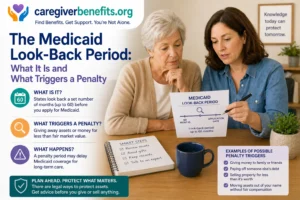
Some people qualify for Medi-Cal based on income only. Others may need to give asset or property information. If income is too high, ask the county about share of cost. You can also read Medicaid spend-down and Medicaid look-back period before making major money or property changes.
VA options for spouses
If the person receiving care is a Veteran, ask about VA caregiver programs. These are separate from Medi-Cal.
VA PCAFC
A spouse can apply to be the family caregiver under VA PCAFC if the Veteran and caregiver meet VA rules. VA says a caregiver may be a spouse, son, daughter, parent, stepfamily member, extended family member, or someone who lives full time with the Veteran or is willing to do so if approved.
The Veteran must meet VA rules. Current VA rules include VA health care enrollment, a VA disability rating of 70% or higher, and a need for at least six months of continuous in-person personal care services.
The Veteran and caregiver apply together. VA uses VA Form 10-10CG. The primary caregiver may receive a monthly stipend if approved. Secondary caregivers may receive some supports, but not the same stipend.
If the spouse signs for the Veteran, VA may ask for proof of legal authority or an allowed signer form. Ask the caregiver support team before sending the application.
Veteran Directed Care
Veteran Directed Care lets eligible Veterans manage a service budget with help from a counselor. The Veteran or representative may hire workers, which may include a family member or neighbor.
This route depends on VA clinical need and local availability. Not every VA medical center has made referrals to Veteran Directed Care. Ask the Veteran’s VA social worker whether it is offered in that area.
VA Aid and Attendance is different
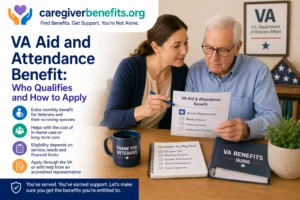
VA Aid and Attendance is not a spouse caregiver wage. It may increase a qualifying VA pension for a Veteran or surviving spouse who needs help with daily activities. The household may then use the money for care costs, but the rules are different.
Learn more at VA Aid and Attendance.
Paid family leave options
California Paid Family Leave can help a working spouse who loses wages while taking time off to care for a seriously ill spouse or registered domestic partner.
This is not the same as being hired as a caregiver. It is short-term wage replacement through the Employment Development Department, called EDD.
You may qualify if you need to care for a family member with a serious health condition, lose wages because you need family leave, are working or looking for work when leave begins, and paid into State Disability Insurance during the required base period. On many paystubs this shows as CASDI.
EDD says PFL can pay up to eight weeks in a 12-month period. The claim needs documents, including medical certification from the care recipient’s licensed health professional.
PFL does not protect your job by itself. California Family Rights Act leave, called CFRA, may protect your job if you meet its rules. CFRA may give eligible workers up to 12 weeks of job-protected leave to care for a spouse or other covered family member with a serious health condition.
Before taking leave, ask your employer or HR office about CFRA, FMLA, sick leave, vacation time, and how PFL fits with your work rules.
What to ask before applying
Use plain words. Ask the office to explain the rule that applies to your case.
Phone script for county IHSS
“I am caring for my spouse at home in California. I need to apply for IHSS or request a reassessment. Can you tell me how the spouse provider rules apply? I need to know which tasks can be paid, whether personal care or paramedical services can be authorized, and what proof you need if you say I am an able and available spouse.”
Phone script if the county says no
“Please tell me the exact rule and service category you are using. Is this denial for all IHSS services, or only for household tasks? Can I get the decision in writing with appeal rights? What proof would you accept for a reassessment?”
Phone script for VA
“My spouse is a Veteran and needs help with daily care at home. Can I speak with the caregiver support team or the VA social worker about PCAFC and Veteran Directed Care? I need to know if a spouse can apply and what forms are needed.”
Phone script for paid leave
“I need time off work to care for my seriously ill spouse. I want to ask about California Paid Family Leave, medical certification, and whether my job may be protected under CFRA or FMLA.”
For more scripts, see caregiver phone scripts.
Documents to gather
- Photo ID for the person needing care and the spouse caregiver.
- Medi-Cal card or Benefits Identification Card, if active.
- Proof of California address.
- Income and asset papers if Medi-Cal asks for them.
- Marriage certificate or registered domestic partner proof if requested.
- Doctor notes, hospital discharge papers, diagnosis list, and medication list.
- A daily task list showing help with bathing, dressing, toileting, transfers, feeding, walking, memory, safety, and appointments.
- Any IHSS Notice of Action, denial, approval, reassessment notice, or hour change.
- Proof the spouse is not available for certain tasks, such as work schedule, health limits, or other unavoidable reasons.
- Proof of job loss, reduced hours, or blocked job search if the spouse left work or could not seek work because no other suitable provider was available.
- For PFL, wage and employment records, leave dates, the claim form, the care recipient signature section, and medical certification.
- For VA, Veteran health care information, VA rating information, discharge papers if needed, and any power of attorney or signer document if someone else signs.
You can also use caregiver checklists to keep papers in one place.
If the answer is no
No can mean different things. It may mean the person does not qualify for Medi-Cal. It may mean IHSS approved hours but denied spouse payment for certain tasks. It may mean the spouse can be paid for personal care but not chores. It may mean the VA program is not available in that location.
Do not stop at a verbal no if the care need is real.
Step 1: Ask what was denied
Ask whether the denial is about eligibility, hours, service category, spouse provider status, timesheets, Medi-Cal share of cost, or missing paperwork.
Step 2: Ask for the notice
For IHSS, ask for the written Notice of Action. The notice should explain the county action and hearing rights.
Step 3: Request a reassessment if the care need changed
New falls, hospital stays, dementia changes, bathing problems, toileting needs, or unsafe wandering can change the case. Give the county new medical proof and a clear daily task list.
Step 4: Ask about another provider
If the spouse cannot be paid for some services, ask if another relative, friend, neighbor, or registry worker can be hired for approved hours.
Step 5: Appeal on time
An IHSS applicant or recipient can ask for a state hearing if they disagree with a county action or believe the county is not giving services they should get. If you ask before the effective date of the county action, benefits may stay the same until the hearing decision.
If payment is not approved, look for other help. Respite, adult day care, home-delivered meals, transportation, and VA pension benefits may still lower the pressure on the household. Start with respite care for caregivers and the care cost calculator.
For taxes, do not guess. IHSS and WPCS live-in provider wages may have special tax rules. See caregiver tax deductions and ask a qualified tax professional about your own return.
FAQ
Can my spouse be paid through IHSS in California?
Sometimes. A spouse may be paid for some authorized IHSS services, such as personal care or paramedical services. Other tasks may be denied under the able and available spouse rules.
Does California Paid Family Leave pay me to be my spouse’s caregiver?
No. PFL is wage replacement when you take time off work to care for a seriously ill spouse or other covered family member. It is not an ongoing caregiver job.
Can a spouse get a VA caregiver stipend?
Yes, if the Veteran and spouse meet VA PCAFC rules and VA approves the application. The Veteran and caregiver apply together.
What if IHSS says a spouse cannot be paid?
Ask if the denial is for all services or only certain tasks. Ask for the written rule, the Notice of Action, and appeal rights. You can also ask what proof would support a reassessment.
Can I be both the spouse caregiver and the representative?
It depends on the program and the form. Ask the county, waiver agency, or VA caregiver team before signing both worker and representative sections. Some programs may require a different person to sign certain timesheets or papers.
Resumen en español
En California, un esposo o esposa a veces puede recibir pago por cuidar a su pareja. La primera llamada suele ser a la oficina de IHSS del condado.
Pregunte si las reglas de “cónyuge capaz y disponible” aplican a su caso. Pida una decisión por escrito si le dicen que no. También pregunte sobre VA, Paid Family Leave, y ayuda de relevo si la persona necesita cuidado en casa.
Official sources used
- California Department of Social Services: IHSS Program
- California Department of Social Services: County IHSS Offices
- California Department of Social Services: IHSS regulations, Division 30
- California Department of Social Services: IHSS Recipient Right to File a Hearing
- California Department of Health Care Services: Apply for Medi-Cal
- California Department of Health Care Services: Medi-Cal Help Center
- California Department of Health Care Services: HCBA Waiver
- California Department of Health Care Services: Waiver Personal Care Services
- California Department of Health Care Services: HCBA Policy Letter 24-003, WPCS Parent and Spouse Providers
- California Department of Aging: Multipurpose Senior Services Program
- U.S. Department of Veterans Affairs: VA PCAFC
- U.S. Department of Veterans Affairs: Veteran Directed Care
- Administration for Community Living: Veteran Directed Care Program
- No Wrong Door: Find a Veteran Directed Care Program
- California Employment Development Department: Paid Family Leave
- California Employment Development Department: Paid Family Leave for Caregivers
- California Civil Rights Department: Family Care and Medical Leave
About this guide
This guide was written for California spouses and families trying to find real payment or leave options. It focuses on official program routes, first calls, documents, denials, and appeal steps.
Disclaimer
This is general information, not legal, tax, medical, or financial advice. For legal or tax questions, talk with a qualified professional in your state. Program rules can change, and local agencies should confirm details for your case.