North Carolina caregiver pay guide
Last checked: May 18, 2026
If you care for your husband or wife in North Carolina, the pay rules are not simple. Some programs may allow spouse caregiver pay, but only when the person getting care meets program rules and the spouse meets worker rules.
This guide shows where to start, what to ask, and what to do if the first answer is no.
Quick answer
Yes, a spouse may be able to get paid as a caregiver in North Carolina, but it depends on the program and the role the spouse has.
The main Medicaid route to ask about is CAP/DA, the Community Alternatives Program for Disabled Adults. CAP/DA can include consumer-directed personal assistance and coordinated caregiving. A spouse may be allowed as a paid worker in some CAP/DA settings, but extra rules may apply if the spouse is also a legal representative, guardian, power of attorney, or other legally responsible person.
Regular caregiver support programs in North Carolina do not pay a spouse for full-time care. VA programs may help some spouses of eligible Veterans.
Start here
- Call for a CAP/DA referral. Ask Acentra Health / NC LIFTSS at 833-522-5429 or 919-568-1717. You can also ask a local CAP/DA case management entity in your county.
- Ask the exact spouse-pay question. Say: “Can my spouse be paid under CAP/DA consumer direction, personal assistance, or coordinated caregiving under current North Carolina rules?”
- Gather proof before the assessment. Start a care log. Write down help needed with bathing, dressing, eating, toileting, mobility, transfers, meals, medicines, supervision, and safety.
Main routes in North Carolina
| Program or route | Who it may help | Can it pay a spouse? | Where to start |
|---|---|---|---|
| CAP/DA Medicaid waiver | Adults age 18 or older who need a nursing facility level of care but want care at home | Possibly. Ask about consumer-directed personal assistance and coordinated caregiving. Extra rules may apply. | Call NC LIFTSS / Acentra Health or a local CAP/DA case management entity. |
| Consumer-directed personal assistance under CAP/DA | CAP/DA members who can direct care or appoint a representative | Possibly. A spouse may be eligible for hire if worker rules are met. A spouse who is also a representative, guardian, power of attorney, or legally responsible person needs special review. | Ask the CAP/DA case manager and financial management service. |
| Coordinated caregiving under CAP/DA | CAP/DA members with a live-in caregiver arrangement | Possibly. This route may pay a live-in caregiver stipend through an approved provider. | Ask the CAP/DA case manager if this service fits the assessment. |
| Personal Care Services (PCS) | NC Medicaid members who need hands-on help with daily activities | Usually not a direct spouse-pay route. PCS is normally provided by trained helpers through licensed agencies or care settings. | Ask the doctor about the DHB-3051 PCS request and NC LIFTSS assessment. |
| VA PCAFC | Spouses caring for eligible Veterans with major service-connected care needs | Yes, if VA approves the Veteran and spouse. The spouse can be the primary family caregiver. | Contact the VA caregiver support team or apply with VA Form 10-10CG. |
| Veteran Directed Care | Veterans who need home and community-based care and have access to this VA service locally | Possibly. Veterans may be able to hire family members or neighbors with a VA-approved spending plan. | Ask the VA social worker if Veteran Directed Care is offered at the local VA medical center. |
| North Carolina Family Caregiver Support Program | Family and informal caregivers who need support, training, respite, or help finding services | No. North Carolina says this program does not pay caregivers for ongoing care. | Contact the Family Caregiver Support Program provider for your area. |
North Carolina rule warning
Rules can change. Counties, Medicaid plans, waiver contractors, case management entities, and agencies may use different names for the same step.
Always confirm the current rule with NC Medicaid, NC LIFTSS / Acentra Health, the CAP/DA case manager, the financial management service, or the VA caregiver support team before you count on pay.
Why spouse caregiver pay is different
A spouse is not treated the same as a neighbor or an outside aide.
Many programs see a spouse as someone who already has a legal or family duty to help. That does not always block pay. But it can add limits, proof, and review.
In North Carolina CAP/DA, the key terms are:
- Beneficiary: the person approved for Medicaid waiver services.
- Consumer direction: a way for the person getting care, or their representative, to help choose and manage the paid worker.
- Personal assistant: the worker hired under the consumer-directed option to help with approved care tasks.
- Representative: a person who helps the beneficiary manage the employer role when the beneficiary cannot do it alone.
- Legally responsible person: a person with a legal duty or legal role. This may include a spouse in some care rules, and may also include a guardian or power of attorney.
The hard part is this: the spouse may want to be both the paid worker and the person who signs or manages things for the beneficiary. That may be allowed in some cases, but it can trigger extra review.
Ask the case manager to tell you which role the spouse is being considered for:
- paid worker only,
- representative only,
- legal guardian or power of attorney only,
- paid worker and representative, or
- live-in caregiver under coordinated caregiving.
Do not rely on a general “yes” or “no.” Ask which rule is being used.
Medicaid options in North Carolina
North Carolina Medicaid is often the first place to check when a spouse needs paid help at home. The person who needs care must meet Medicaid rules first. Then the care service and worker must be approved.
CAP/DA: the main Medicaid route to ask about
CAP/DA stands for Community Alternatives Program for Disabled Adults. It is a North Carolina Medicaid home and community-based waiver.
CAP/DA is for adults age 18 or older with serious health needs who meet a nursing facility level of care but want to stay at home or in another community setting.
To use CAP/DA, the person must meet the medical and Medicaid rules. North Carolina also says CAP/DA members must be enrolled in NC Medicaid Direct.
CAP/DA can include services such as in-home aide care, respite, medical supplies, home changes, personal assistance, financial management, consumer direction, and coordinated caregiving.
For spouse pay, ask about these two CAP/DA routes first:
- Consumer-directed personal assistance. This is the route where the person getting care, or a representative, helps choose and manage a personal assistant.
- Coordinated caregiving. This is a live-in caregiver route. It may include a stipend paid through an approved provider agency.
Can the spouse be the worker under CAP/DA?
Possibly.
North Carolina CAP/DA policy says a spouse may be eligible for hire for consumer-directed personal assistance when the spouse meets the worker requirements. These can include being at least 18, passing required checks, meeting competency rules, and not having other work that gets in the way of the approved care.
But the spouse’s other role matters. If the spouse is also the representative, legal guardian, power of attorney, health power of attorney, or legally responsible person, ask the case manager if special or extraordinary conditions must be shown.
Do not assume that being married is enough. Do not assume it blocks pay either. Ask for the exact current CAP/DA rule.
Can the spouse be the representative and paid worker?
It depends.
Under consumer direction, a representative may help the person manage the employer role. But the same person being both the representative and paid worker can raise a conflict or extra review.
Ask this on the phone:
“If I am my spouse’s representative or power of attorney, can I also be paid as the personal assistant? If not, can another trusted person serve as representative while I apply to be the worker?”
If the answer is no, ask if the reason is a role conflict, missing documents, worker screening, care level, lack of waiver approval, or lack of a waiver slot.
Coordinated caregiving under CAP/DA
Coordinated caregiving is another CAP/DA service to ask about. It is built around a live-in caregiver arrangement.
Under this route, the live-in caregiver may receive a stipend for care tasks described in the care plan. The person may live in the care recipient’s home or the caregiver’s home. The home must meet program requirements.
A spouse should ask if coordinated caregiving is available in the case, whether a spouse can be the live-in caregiver, how the stipend is paid, what provider agency is involved, and whether other services can also be approved.
Personal Care Services (PCS)
PCS is a different Medicaid service. It helps with daily tasks like eating, dressing, bathing, toileting, and mobility.
PCS may help the person get care at home, but it is usually not the best route if your goal is direct spouse pay. North Carolina describes PCS as care given by trained helpers who work for licensed home care agencies or adult care homes.
PCS can still be important if CAP/DA is not approved yet, if the person does not meet CAP/DA rules, or if the family needs an agency aide.
If PCS hours are approved but too low, ask about the PCS reconsideration process. For some adults age 21 or older who get an initial PCS approval for less than 80 hours per month, North Carolina has a Request for Reconsideration of PCS Authorization form. The timing is strict, so read the notice and ask NC LIFTSS before the window closes.
What about Structured Family Caregiving?
Some states use the phrase “Structured Family Caregiving.” North Carolina’s official CAP/DA materials use the term coordinated caregiving.
When you call, use North Carolina’s term first. Say: “I am asking about CAP/DA coordinated caregiving and whether a spouse can be the live-in caregiver.”
How to apply for Medicaid first
If your spouse does not already have Medicaid, start with the Medicaid application.
North Carolina says you can apply online through ePASS, in person at local DSS, by phone through local DSS, or by mail, email, fax, or drop off at DSS.
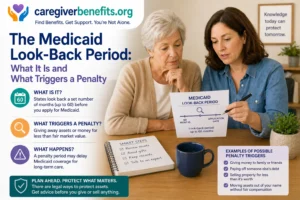
For long-term care cases, ask for help with the aged, blind, disabled, or long-term care Medicaid category. If income or assets are the issue, read our guides to Medicaid spend-down and the Medicaid look-back period.
Phone script for North Carolina Medicaid
Use this when you call NC LIFTSS, a CAP/DA case management entity, or local DSS.
“Hi, I care for my spouse at home in North Carolina. They need help with daily care, including [list the tasks]. I want to ask about CAP/DA, consumer-directed personal assistance, and coordinated caregiving. Can you tell me how to request a CAP/DA referral and whether a spouse can be paid under current rules?”
“If the spouse cannot be paid in our case, can you tell me the exact reason and what other route we should try?”
More scripts are here: caregiver phone scripts.
Documents to gather before you apply
- NC Medicaid card, if your spouse already has Medicaid
- Medicare card and other insurance cards
- Photo ID and proof of North Carolina address
- Social Security number
- Income proof, bank statements, pension letters, and other benefit letters
- Marriage certificate, if asked
- Power of attorney, guardianship order, or health care power of attorney, if any
- Doctor notes, diagnoses, medicine list, hospital papers, and discharge orders
- A care log showing help needed each day
- Proof of falls, wandering, unsafe cooking, missed medicine, or other safety risks
- Letters from home care agencies if they cannot staff the case
- Work records if caregiving has caused missed work, reduced hours, or job loss
- Two proofs of shared address if asking about paid live-in caregiver rules
Use our caregiver checklists to keep papers in one place.
VA options for spouses
If your spouse is a Veteran, check VA routes even if Medicaid says no.
VA PCAFC
VA PCAFC is the main VA family caregiver stipend program. A spouse can be a family caregiver if the Veteran and caregiver meet VA rules.
VA says the caregiver must be at least 18 and must be the Veteran’s spouse, child, parent, stepfamily member, extended family member, or live with the Veteran full time or be willing to do so if approved.
VA also looks at the Veteran’s service-connected disability rating, need for in-person personal care for at least six months, VA health care enrollment, and other rules.
To apply, the Veteran and caregiver submit VA Form 10-10CG together. The local VA caregiver support team will review the case. If approved, the primary family caregiver may get a monthly stipend and other supports.
Veteran Directed Care
Veteran Directed Care is different from PCAFC. It helps some Veterans receive home and community-based services in a self-directed way.
VA says Veterans in this program may get a budget for services. With help from a counselor, the Veteran or representative can hire workers, which may include a family member or neighbor.
This program is not offered everywhere. Ask the VA social worker at the Veteran’s VA medical center if Veteran Directed Care is available and whether a spouse may be hired in your case.
VA Aid and Attendance
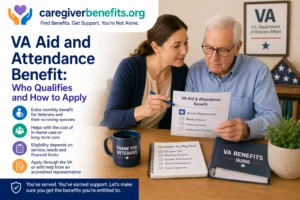
VA Aid and Attendance is not a direct spouse paycheck. It is an added VA pension amount for some wartime Veterans or surviving spouses who need help with daily care.
It may still help the household pay for care. Learn more in our VA Aid and Attendance guide.
Paid family leave options
North Carolina does not have a broad state paid family leave insurance program for private workers.
That means many spouse caregivers must check three places:
- Federal FMLA. If you qualify, the Family and Medical Leave Act may give up to 12 weeks of unpaid, job-protected leave to care for a spouse with a serious health condition.
- Your employer policy. Ask HR about paid time off, sick leave, donated leave, short-term disability rules, flexible schedule, and remote work.
- Union or contract benefits. If you work under a contract, ask for the written leave section.
North Carolina Department of Labor says employers are not required by state wage law to give paid wage benefits such as vacation or sick leave unless the employer has promised them by policy, agreement, or practice.
FMLA does not pay you by itself. It protects eligible time away from work. Ask HR for the medical certification form and the deadline to return it.
What to ask before applying
Use these questions before you fill out forms or quit work.
Ask Medicaid or CAP/DA
- Is my spouse already in NC Medicaid Direct?
- Does my spouse need a CAP/DA referral?
- Is there a wait or limited slot issue?
- Can a spouse be hired for consumer-directed personal assistance?
- Can a spouse be approved as a live-in caregiver under coordinated caregiving?
- If I am power of attorney or representative, can I also be paid?
- What special or extraordinary proof is needed?
- Who is the financial management service?
- What background checks, training, or forms must I complete?
Ask PCS
- Is this a PCS case or a CAP/DA case?
- Who must submit the DHB-3051 request?
- When will the in-person assessment happen?
- What daily tasks count toward eligibility?
- If hours are too low, can we request reconsideration?
- What is the deadline?
Ask the VA
- Is my spouse enrolled in VA health care?
- Could we apply for PCAFC?
- Is Veteran Directed Care offered at this VA medical center?
- Can the spouse be the paid caregiver?
- Should we also ask about Aid and Attendance?
If the answer is no
A “no” can mean many things. Do not stop until you know which one it is.
Step 1: Ask for the reason in writing
Ask: “Is this a denial of Medicaid eligibility, a denial of CAP/DA, a denial of a service, a denial of spouse worker approval, or a denial because I am also the representative?”
Step 2: Ask what rule applies
Ask for the policy name, form name, or notice section. Write down the person’s name, agency, date, and exact words.
Step 3: Ask about a different route
If a spouse cannot be paid as the personal assistant, ask about coordinated caregiving, an agency aide, PCS, respite, adult day health, or VA options.
Step 4: Watch appeal deadlines
If Medicaid denies, reduces, suspends, or ends a service, you should receive written notice and appeal rights. Read the notice right away. Some deadlines are short.
If PCS hours are too low after an initial approval, ask whether the PCS reconsideration form applies. If the issue is a Medicaid service denial, ask how to file the hearing request form.
Step 5: Get backup help
Call the NC Medicaid Contact Center, local DSS, the NC Medicaid Ombudsman, Legal Aid of North Carolina, Disability Rights North Carolina, or the VA caregiver support team if the case is stuck.
Other help if spouse pay does not work
Spouse caregiver pay is only one path. The household may still be able to reduce costs or get more support.
- Use the care cost calculator to compare paid help, lost work time, and respite costs.
- Read respite care options if you need breaks or backup care.
- Check caregiver tax deduction basics before tax time.
- Review Medicaid HCBS waivers to understand how waiver services differ from regular Medicaid.
FAQ
Can my husband or wife pay me from Medicaid in North Carolina?
Not by handing you the Medicaid card. Pay must go through an approved Medicaid service, care plan, and payroll or provider process. CAP/DA is the main route to ask about.
Can a spouse be paid under regular PCS?
PCS is normally agency-based. It may help your spouse get hands-on care, but it is usually not the direct spouse-pay route. Ask about CAP/DA consumer direction if spouse pay is the goal.
Can I be paid if I am also power of attorney?
Maybe, but this needs careful review. CAP/DA rules may require special or extraordinary circumstances if the paid worker is also a representative, guardian, power of attorney, or legally responsible person. Ask the case manager before you sign up.
Can VA pay a spouse caregiver?
Yes, in some cases. VA PCAFC can approve a spouse as a family caregiver if the Veteran and spouse meet VA rules. Veteran Directed Care may also allow family hiring if offered locally and approved in the spending plan.
Does North Carolina have paid family leave for spouse care?
North Carolina does not have a broad state paid family leave insurance program for private workers. Check federal FMLA, employer-paid leave, union leave, and written workplace policies.
What should I do first?
If the person has serious daily care needs, call NC LIFTSS / Acentra Health and ask about CAP/DA. If the person is a Veteran, also call the VA caregiver support team.
About this guide
This guide is for family caregivers in North Carolina who need a practical place to start. It focuses on payment, Medicaid, VA caregiver routes, leave, forms, and next calls.
This is general information, not legal, tax, medical, or financial advice. For legal or tax questions, talk with a qualified professional in your state.
Official sources used
- NC Medicaid: Community Alternatives Program for Disabled Adults (CAP/DA)
- NC Medicaid provider page: CAP/DA
- NC Medicaid Clinical Coverage Policy 3K-2: CAP/DA
- NC LIFTSS / Acentra Health: CAP/DA
- NC LIFTSS / Acentra Health: CAP/DA beneficiaries and families
- NC Medicaid: Personal Care Services (PCS)
- NC Medicaid: Adult Care Home and PCS forms
- NC Medicaid: PCS reconsideration request
- NC Medicaid: How to apply
- NC DHHS: Family Caregiver Support Program
- NC Medicaid: Medicaid recipient due process and appeal rights
- VA: PCAFC family caregiver assistance page
- VA: Veteran Directed Care
- Administration for Community Living: Veteran Directed Care Program
- U.S. Department of Labor / NC DOL: FMLA poster
- NC Department of Labor: promised wages and wage benefits