Legal rights
Last checked: May 2026
A doctor’s letter can help show why your loved one needs care at home, VA help, or time off work under FMLA.
The letter must be clear. It should not just list a diagnosis. It should explain what the person cannot do safely without help.
Quick answer
A strong doctor’s letter should explain three things:
- the person’s medical condition,
- the daily tasks they need help with, and
- why care, leave, or support is medically needed now.
For Medicaid home care, the letter can support the state’s home care or HCBS assessment. It does not replace the assessment. Medicaid says HCBS can let people get services in their home or community instead of an institution, but states set many details within federal rules. Medicaid.gov explains HCBS.
For VA Aid and Attendance, the VA often uses VA Form 21-2680. For VA caregiver support through PCAFC, the VA uses its own application and review process. VA caregiver support information is here.
For FMLA, your employer may ask for medical certification from the health care provider. The U.S. Department of Labor says the employee is usually responsible for giving a complete and sufficient certification within 15 calendar days after the employer asks. The DOL explains FMLA certification.
Who this helps
This guide is for a family caregiver who needs medical proof for one of these needs:
- Medicaid home care or an HCBS waiver.
- More home care hours or a new care plan.
- VA Aid and Attendance for a veteran or surviving spouse.
- VA caregiver support through PCAFC.
- FMLA leave to care for a spouse, parent, or child.
- An appeal after a denial.
This is not about a general sick note. It is about proof for benefits, coverage, care hours, leave, or an appeal.
Why medical proof matters
Many programs do not approve help just because someone has a diagnosis. They look at what the person can and cannot do each day.
For home care, the reviewer may ask about ADLs and IADLs.
ADLs
ADLs are basic daily tasks. They often include bathing, dressing, eating, using the toilet, moving from a bed or chair, walking, and grooming.
IADLs
IADLs are tasks that help a person live at home. They can include meals, medicine reminders, shopping, housework, transportation, phone use, and money tasks.
CMS gives examples of daily living tasks such as bathing, managing medicine, getting dressed, cooking, and managing money. CMS lists examples of these tasks.
A good letter connects the diagnosis to daily care needs. For example, “dementia” alone may not show enough. The letter should say if the person wanders, misses medicine, cannot bathe without cueing, or cannot be left alone safely.
What may pay or help
The same medical facts may help with more than one path. But each program has its own rules and forms.
| Path | What it may help with | What proof should show |
|---|---|---|
| Medicaid home care or HCBS | Home care, personal care, adult day services, respite, or other state-approved help. | ADL or IADL help, safety risks, and why care at home is needed. |
| VA Aid and Attendance | An added amount for some veterans or survivors who qualify for VA pension and need help with daily activities or are housebound. | Need for regular aid, daily help, and housebound status if that applies. |
| VA PCAFC caregiver support | Support for eligible family caregivers of eligible veterans through the VA process. | Care needs, supervision needs, and the caregiver’s role. |
| FMLA | Job-protected leave for eligible workers of covered employers. It is often unpaid unless paid leave also applies. | Serious health condition, care needed, and expected leave schedule. |
For more on home care, see Medicaid HCBS waivers explained. If you are trying to get paid as a family caregiver, start with Can I get paid to be a caregiver?
Who may qualify
A doctor letter does not make someone qualify by itself. It supports the application.
Medicaid home care
The person must usually meet Medicaid financial rules and care need rules. These rules vary by state and by program.
Some people apply through regular Medicaid personal care. Some apply through an HCBS waiver. Some states use managed care plans. Some programs have waitlists.
Medicaid.gov says states can develop HCBS waivers within broad federal rules for people who prefer long-term care at home or in the community instead of an institution. Read Medicaid.gov’s 1915(c) HCBS waiver page.
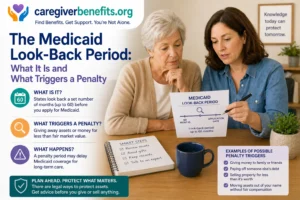
If money or assets may be an issue, read Medicaid spend-down and the Medicaid look-back period.
VA Aid and Attendance
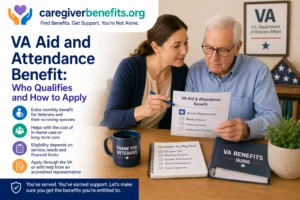
VA Aid and Attendance or Housebound benefits are added to a monthly VA pension for qualified veterans and survivors. The VA says these benefits may apply if a person needs help with daily activities or is housebound. VA.gov explains Aid and Attendance and Housebound benefits.
Medical proof is only one part. VA pension rules also look at service, income, net worth, and other facts.
VA PCAFC support
PCAFC has its own VA rules. The caregiver must be at least 18. The veteran and caregiver must meet VA program rules. Check the VA page or a local VA caregiver support team before assuming eligibility.
FMLA
FMLA can help eligible workers take job-protected leave for family and medical reasons. The DOL says FMLA applies to eligible employees of covered employers and may be unpaid. Read DOL Fact Sheet #28.
Some states have paid family leave or broader leave rules. Check your state labor department if you need paid leave or if FMLA does not cover you.
Where to start first
- Name the goal. Write down what you need: Medicaid home care, more care hours, VA help, FMLA leave, or an appeal.
- Get the right form. Do not ask for a vague letter if the program has its own form.
- List the daily care problems. Include falls, missed medicine, bathing help, unsafe cooking, wandering, transfers, toileting, meals, and supervision.
- Ask the doctor to be specific. The letter should explain daily care needs, not just the diagnosis.
- Keep proof. Save the letter, forms, fax proof, upload proof, and the date you sent each item.
For Medicaid, start with your state
Medicaid home care rules are state-based. A national article can only give the starting point.
Start with your state Medicaid agency, your Medicaid managed care plan if the person has one, or your local Aging and Disability Resource Center or Area Agency on Aging.
The Administration for Community Living says the Eldercare Locator connects older adults and caregivers with local support resources, including home care, transportation, meals, caregiver training, and breaks from caregiving. ACL explains the Eldercare Locator. You can also search at Eldercare Locator.
What the doctor’s letter should say
The letter should be short, clear, and tied to the benefit you need. It should be on office letterhead if possible. It should include the provider’s name, title, phone number, date, and signature.
Ask the doctor to include these points
- Patient name and date of birth.
- Diagnoses that cause care needs.
- How long the condition has lasted or is expected to last.
- ADLs the person needs help with.
- IADLs the person needs help with.
- Safety risks, such as falls, wandering, choking, missed medicine, or unsafe cooking.
- Need for hands-on help, cueing, supervision, or standby help.
- Whether the person can be left alone safely.
- Why home care, leave, or caregiver help is medically needed.
- How often help is needed, if the provider can say.
Sample wording you can ask for
Please describe the patient’s daily care needs. Please include help needed with bathing, dressing, toileting, transfers, walking, eating, medicine, meals, transportation, and safety supervision. Please explain why these needs are due to the medical condition and why help at home or caregiver leave is needed.
Do not ask the doctor to say something that is not true. The best letter is honest and specific.
For Medicaid home care, the assessment still matters
Many Medicaid home care programs require a state or plan assessment. The doctor’s letter can support that assessment. It may not decide the case by itself.
Medicaid.gov says functional assessments are tools that states, providers, and managed care plans use to collect information on people applying for or getting Medicaid HCBS and long-term services and supports. Medicaid.gov also says these tools vary across the country. Read Medicaid.gov’s page on functional assessments.
Tip
Before the Medicaid assessment, write a one-week care log. List each time you help with bathing, dressing, meals, medicine, toileting, transfers, falls, confusion, or unsafe behavior.
For VA Aid and Attendance or PCAFC, use VA forms when needed
For Aid and Attendance, do not rely only on a free-form letter. The VA has a specific form for housebound status or regular Aid and Attendance.
VA Form 21-2680 is called Examination for Housebound Status or Permanent Need for Regular Aid and Attendance. VA.gov says the form is used to apply for Aid and Attendance benefits added to monthly compensation or pension benefits.
For PCAFC, the VA uses VA Form 10-10CG. The form says VA uses the information to help decide eligibility.
A doctor letter may still help explain daily care needs. But use the VA form when VA asks for it. If you are looking at VA pension help, see VA Aid and Attendance.
For FMLA, ask for certification, not just a note
For FMLA, your employer may give you a form. Many employers use the DOL form for a family member’s serious health condition.
The DOL form WH-380-F is for certification of a family member’s serious health condition. The form says an employer may require medical certification from the family member’s health care provider and must give the employee at least 15 calendar days to provide it.
The certification should explain the medical facts, the need for care, and the expected leave schedule. If you need leave in blocks, say that. If you need leave now and then for appointments or sudden care gaps, ask the provider to describe that if true.
Phone script: calling the doctor’s office
Hello, my name is [your name]. I help care for [patient name]. We are applying for [Medicaid home care / VA Aid and Attendance / VA PCAFC / FMLA]. We need medical proof of daily care needs.
Can the doctor complete the required form or write a letter that lists the patient’s diagnosis, ADL and IADL limits, safety risks, and why help is medically needed?
What is the best way to send the form? Is there a fee? How long does it usually take? Can you call me if anything is missing?
For more scripts, see caregiver phone scripts.
What documents may be needed
The program may not need every item on this list. Ask the agency, plan, employer, or VA what they require.
- Doctor letter or medical certification form.
- Current diagnosis list and medicine list.
- Recent visit notes, if allowed.
- Hospital discharge papers.
- Therapy notes that show walking, transfer, strength, memory, or safety limits.
- Fall reports or emergency room records.
- Care log from the family caregiver.
- Power of attorney or health care proxy, if you are signing or speaking for the person.
- Medicaid notice, VA letter, employer FMLA packet, or denial letter.
- Proof of identity, address, income, assets, insurance, or veteran status if the program asks for it.
If you manage papers for an aging parent, read power of attorney for an aging parent. You may also want caregiver checklists.
What usually goes wrong
- The letter only lists diagnoses. A diagnosis does not always prove daily care need.
- The letter is too vague. Phrases like “needs help” or “cannot live alone” may not be enough.
- The wrong form is used. VA and FMLA often use specific forms.
- The doctor does not mention safety. Falls, wandering, missed medicine, and unsafe cooking can matter.
- The family forgets IADLs. Meals, shopping, transportation, medicine, and money tasks can show why home help is needed.
- The family waits too long. FMLA deadlines and appeal deadlines can be short. Check the notice.
- No one keeps proof of delivery. Keep fax receipts, upload screens, mail tracking, and names of people you spoke with.
What to do if the first path does not work
A no is not always the end. First, find out why the request failed.
- Ask for the reason in writing. Do not rely only on a phone answer.
- Check what proof was missing. Was it medical proof, financial proof, a form, a signature, or a deadline?
- Ask for the appeal deadline. Write the date on paper and on your phone.
- Ask the doctor for a clearer letter. Use the denial reason to focus the update.
- Ask about another route. Medicaid, VA, aging services, respite, and employer leave rules are not the same.
If a hospital discharge is part of the problem, see hospital discharge rights. If Medicare denied a service, read how to appeal a Medicare denial.
Soft warning
Do not miss an appeal deadline while waiting for a perfect doctor letter. File on time if the notice tells you how. Then ask how to send more proof.
Short written request you can send to the doctor
Dear Dr. [Name],
We are applying for [program or leave type] for [patient name]. The agency or employer needs medical proof of daily care needs.
Please complete the attached form or write a letter on office letterhead. Please include the diagnosis, how it affects daily life, ADLs and IADLs that need help, safety risks, supervision needs, and why care or leave is medically needed.
Please let us know if you need a visit first or if there is a fee.
Thank you,
[Your name and phone number]
Official sources used for this update
We checked these official sources in May 2026:
- Medicaid.gov: Home & Community Based Services
- Medicaid.gov: 1915(c) HCBS waivers
- Medicaid.gov: functional assessments
- CMS: Personal Care Services
- VA.gov: Aid and Attendance and Housebound benefits
- VA Form 21-2680
- VA caregiver support: PCAFC
- VA Form 10-10CG
- U.S. Department of Labor: FMLA Fact Sheet #28
- U.S. Department of Labor: FMLA certification
- DOL Form WH-380-F
- ACL: Getting Started with local help
- ACL Eldercare Locator
Resumen en español
Una carta del doctor puede ayudar con cuidado en casa por Medicaid, beneficios del VA, o permiso FMLA.
La carta debe decir más que el diagnóstico. Debe explicar qué ayuda necesita la persona cada día. Por ejemplo: bañarse, vestirse, comer, usar el baño, caminar, tomar medicinas, preparar comidas, transporte, o supervisión por seguridad.
Para Medicaid, las reglas cambian por estado. Para beneficios del VA y FMLA, use los formularios oficiales cuando se los pidan. Guarde copias de todo.
About This Guide
CaregiverBenefits.org writes guides for family caregivers who need clear steps, official links, and benefit paths that may apply to real care problems.
This guide focuses on medical proof for Medicaid home care, VA benefits, and FMLA. It is a starting point. State Medicaid agencies, the VA, employers, and courts may use their own forms and rules.
Plain disclaimer
This guide is general information. It is not legal, medical, tax, or benefits advice. Rules can change. Always check the official program, your state Medicaid agency, the VA, your employer, or a qualified advisor for your case.
FAQ
Can a doctor’s letter get Medicaid home care approved?
It can help, but it usually does not approve care by itself. Medicaid home care often requires a state or plan assessment.
What should a doctor letter say for home care?
It should list the diagnosis, daily tasks the person needs help with, safety risks, supervision needs, and why help at home is medically needed.
What are ADLs?
ADLs are basic daily tasks like bathing, dressing, eating, toileting, walking, grooming, and moving from a bed or chair.
What are IADLs?
IADLs are daily home tasks like meals, medicine, shopping, transportation, housework, phone use, and money tasks.
Does VA Aid and Attendance need a doctor letter?
The VA often uses VA Form 21-2680. A doctor letter may help, but use the VA form when it is required.
Can a doctor letter help with VA PCAFC?
It may help explain care needs, but PCAFC uses the VA’s own application and review process.
Can I use the same letter for Medicaid, VA, and FMLA?
Sometimes the same facts help. But each program may need its own form. Ask the doctor to complete the exact form if one is required.
What if the doctor refuses to write the letter?
Ask if the office will complete the program form instead. You can also ask for recent visit notes, therapy notes, or a referral to the right provider.