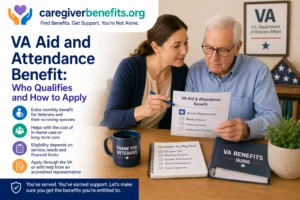
Veteran caregiver benefits
Last checked: May 2026
The VA PCAFC caregiver stipend is one of the main VA programs that may pay a family caregiver. But it is not open to every veteran or every helper.
This guide explains what PCAFC is, who may qualify, how to apply, what papers may be needed, and what to do if VA says no.
Quick answer
PCAFC stands for the VA Program of Comprehensive Assistance for Family Caregivers. It may give a monthly stipend to the approved Primary Family Caregiver of an eligible veteran.
The caregiver does not apply alone. The veteran and caregiver apply together using VA Form 10-10CG or the VA online application.
The veteran usually must have a VA disability rating of 70% or higher, need in-person personal care for at least 6 continuous months, and be enrolled in VA health care. The caregiver must be at least 18 and must be a qualifying family member or live full time with the veteran, or be willing to live full time with the veteran if VA approves the caregiver.
Only the Primary Family Caregiver may get the monthly stipend. Secondary caregivers may get some supports, but not the monthly stipend.
Who this helps
This page is for a spouse, adult child, parent, relative, or full-time helper caring for a veteran at home.
It may help if:
- The veteran needs hands-on help with bathing, dressing, eating, moving, or staying safe.
- The veteran has a service-connected disability rating of 70% or higher.
- You provide daily care and want to know if VA may pay a stipend.
- You were denied and need to know the next step.
- You are confused about PCAFC versus VA Aid and Attendance.
This page is not for every VA benefit. It is focused on PCAFC, the caregiver stipend, and the support tied to that program.
What PCAFC is
PCAFC is part of the VA Caregiver Support Program. VA says the program supports eligible veterans and service members who need personal care from a family caregiver.
The full name is the Program of Comprehensive Assistance for Family Caregivers. Most people call it PCAFC or the VA caregiver stipend program.
PCAFC is not a state Medicaid program. It is a VA program. But the process is handled through the veteran’s local VA Caregiver Support Program team.
VA may approve one Primary Family Caregiver and up to two Secondary Family Caregivers. The Primary caregiver is the main caregiver. Secondary caregivers are backup helpers.
Important
Do not assume that being a spouse or adult child is enough. VA also looks at the veteran’s disability rating, care needs, home setting, and the caregiver’s role.
What may pay or help
PCAFC may help in more than one way. The biggest benefit for many families is the monthly stipend for the Primary Family Caregiver.
VA lists these PCAFC supports for eligible Primary and Secondary Family Caregivers:
- Caregiver education and training.
- Mental health counseling.
- Certain travel benefits when traveling with the veteran for care.
VA lists these added supports for eligible Primary Family Caregivers:
- A monthly stipend.
- CHAMPVA health care benefits if the caregiver does not already qualify for another health care plan.
- At least 30 days of respite care each year.
- Legal and financial planning services related to the veteran’s needs.
- Access to VA virtual psychotherapy for caregivers.
- Access to military commissaries, exchanges, and certain recreation retail facilities.
| Possible help | Who it may help | What to know |
|---|---|---|
| PCAFC monthly stipend | Approved Primary Family Caregiver | VA sets the level. Do not rely on old dollar amounts online. |
| Respite care | Approved Primary Family Caregiver | VA says at least 30 days per year for PCAFC Primary caregivers. |
| Training and counseling | Primary and Secondary Family Caregivers | Ask the local VA Caregiver Support Program team what is offered near you. |
| CHAMPVA | Some approved Primary Family Caregivers | This may apply only if the caregiver does not already have another health care plan. |
| PGCSS | Many caregivers of veterans in VA care | This is VA caregiver support without the PCAFC stipend. |
| Aid and Attendance | Veterans or survivors who qualify for VA pension or certain VA benefits | This is different from PCAFC. It is not a caregiver stipend. |
How the monthly stipend works
The monthly stipend is for the approved Primary Family Caregiver only.
VA bases the stipend on a monthly stipend rate tied to the Office of Personnel Management General Schedule grade 4, step 1, for the locality pay area where the eligible veteran lives. VA then applies the veteran’s care level.
VA uses two stipend levels. Level One is a lower percentage of the monthly stipend rate. Level Two is for a veteran VA finds unable to self-sustain in the community for PCAFC purposes.
This guide does not list dollar amounts because rates can change by year, location, and VA decision. The safest source is the VA stipend notice or the VA monthly stipend fact sheet.
Do not plan your budget from a blog number
Many pages online give sample stipend amounts. Some are old. Some are for one city. Some are estimates. Ask VA how your stipend level and locality rate would be set.
VA also says caregivers receiving a PCAFC stipend must use direct deposit through VA’s Customer Engagement Portal. You may need your Social Security number, address, bank routing number, and account number when setting that up.
Who may qualify
VA looks at both sides: the veteran and the caregiver.
Veteran eligibility basics
VA says all of these must be true for the veteran:
- The veteran has a VA disability rating of 70% or higher. This can be one rating or a combined rating.
- The veteran was discharged from the U.S. military or has a date of medical discharge.
- The veteran needs at least 6 months of continuous, in-person personal care services.
- The veteran is enrolled in VA health care.
VA says personal care can include help with health and well-being, everyday personal needs, and safety, protection, or instruction in the daily living setting.
For PCAFC, the need for care may be based on help with an activity of daily living, supervision or protection due to symptoms or an injury, or regular instruction or supervision without which the veteran’s daily function would be seriously impaired.
Caregiver eligibility basics
VA says the caregiver must be at least 18 years old.
At least one of these must also be true:
- The caregiver is the veteran’s spouse, son, daughter, parent, stepfamily member, or extended family member.
- The caregiver lives full time with the veteran.
- The caregiver is willing to live full time with the veteran if VA approves the caregiver.
The caregiver must also be able to take part in the application process, assessments, training, and home-care assessment if VA moves the application forward.
Where to start first
Start with the veteran’s local VA Caregiver Support Program team. They can explain the PCAFC process and connect the application to the VA facility where the veteran gets care.
- Check the basic fit. Look at the veteran’s VA disability rating, VA health care enrollment, and daily care needs.
- Call the VA Caregiver Support Line. The number is 1-855-260-3274. Ask to be connected with the local Caregiver Support Program team.
- Find the local team. VA has a Caregiver Support Program team locator.
- Apply together. The veteran and caregiver apply using VA’s PCAFC application page or VA Form 10-10CG.
- Answer the intake call. A local VA team member should contact the veteran or caregiver after VA gets the application.
- Take the assessments seriously. VA may review the veteran’s medical record, assess the veteran, assess each caregiver applicant, and complete a functional assessment.
- Complete caregiver training if VA moves the application forward. VA may require caregiver training before approval.
- Prepare for the home-care assessment. VA may assess the veteran and caregiver in the veteran’s home.
You can apply online, by mail, or in person. If applying by mail, VA lists this address for Form 10-10CG:
10-10CG Evidence Intake Center
PO Box 5154
Janesville, WI 53547-5154
VA says not to send medical records with the initial application. If VA needs records, the VA team can explain what to provide and when.
Phone script for the first call
Call: VA Caregiver Support Line at 1-855-260-3274.
Use this script:
Hello. I care for a veteran at home and want to ask about PCAFC. The veteran has a VA disability rating of about [rating] and needs help with [bathing, dressing, meals, safety, medication reminders, transfers, or supervision]. Can you connect me with the local Caregiver Support Program team and tell me how to start VA Form 10-10CG?
Ask these questions before you hang up:
- Which VA facility or Caregiver Support Program team will handle this?
- Should we apply online, by mail, or in person?
- What should we have ready for the intake call?
- What should we not send with the first application?
- How do we check the status later?
Documents and information that may be needed
You may not need every item on this list. But it helps to gather these before you apply or before VA calls.
- VA Form 10-10CG if applying on paper.
- The veteran’s full legal name, date of birth, contact information, and VA health care details.
- The caregiver’s full legal name, date of birth, contact information, and relationship to the veteran.
- Names of any Primary or Secondary caregiver applicants.
- A plain list of the veteran’s daily care needs.
- Notes about falls, wandering, confusion, safety risks, bathing help, dressing help, toileting help, feeding help, transfers, or supervision needs.
- A medication list and names of VA and non-VA doctors, if helpful for the assessment.
- Legal authority papers if someone signs for the veteran. VA lists a valid power of attorney, guardianship order, VA Form 21-0972, VA Form 21-22, VA Form 21-22a, or another state-recognized legal document as possible proof.
- Direct deposit information if VA approves the Primary caregiver for a stipend.
- The denial letter if you are asking about an appeal or review.
For more help with legal authority, see our guide to power of attorney for an aging parent. If you are trying to compare VA pay with other caregiver pay paths, see Can I Get Paid to Be a Caregiver?
Your local VA team matters
PCAFC is a national VA program. But you still need the local VA Caregiver Support Program team because that team helps with intake, contact, local questions, and the application process.
Use the VA team locator or the Caregiver Support Line. Search by the VA facility where the veteran gets care or expects to get care.
If the veteran does not meet PCAFC rules, ask the same team about the Program of General Caregiver Support Services, called PGCSS. VA says PGCSS can offer skills training, coaching, supportive counseling, support groups, peer support mentoring, and referrals. PGCSS does not require the same stipend approval.
What usually goes wrong
PCAFC denials and delays often happen because the family and VA are not looking at the same facts.
- The veteran does not have a 70% or higher VA disability rating. PCAFC uses this as a basic rule.
- The care need is real, but not shown clearly. The caregiver may say, “I do everything,” but VA needs details about specific daily tasks and safety needs.
- The caregiver describes chores, not personal care. Housework and errands matter, but PCAFC focuses on in-person personal care needs.
- The veteran has good days during the assessment. Be honest about the bad days, night care, supervision, and what happens without help.
- Families mix up PCAFC with Aid and Attendance. These are different benefits with different forms and rules.
- The application is missing signatures. VA Form 10-10CG is a joint application. The veteran and caregiver applicants must sign their parts.
- The caregiver misses calls or letters. VA may need intake, training, or assessment steps before approval.
- The family gives up after a denial. VA decisions can have review and appeal options. Read the decision letter closely.
What to do if VA says no
First, read the full VA decision letter. Do not rely only on a phone summary.
Look for the reason. The next step depends on why VA denied the application. A denial based on the veteran’s rating is different from a denial based on care needs, caregiver fit, or VA’s view of the home-care assessment.
VA says PCAFC decisions come with review and appeal rights. VA points caregivers to VA Form 10-305 and PCAFC review and appeal information.
For decisions made on or after February 19, 2019, VA lists several options. These may include:
- Supplemental Claim. This may fit if you have new and relevant evidence VA did not consider.
- Higher-Level Review. This may fit if you think VA made an error, but you are not adding new evidence.
- Board Appeal. This asks the Board of Veterans’ Appeals to review the decision.
- Clinical Appeal. This asks for review through the VA health care side when the issue is a clinical decision.
Deadlines can matter. VA says some review paths have a 1-year deadline from the decision date. Check your decision letter and VA’s family caregiver program review and appeal page.
Do not send a random letter and hope it counts
Use the form and address VA gives for PCAFC review or appeal. PCAFC has its own review information. If you are unsure, call the Caregiver Support Line and ask what form applies to your decision date.
You can also ask for help from a VA-accredited representative or Veterans Service Organization. An accredited helper may be useful if the denial letter is hard to understand or if you need to gather evidence.
PCAFC is different from Aid and Attendance
This mix-up causes a lot of wasted calls.
PCAFC is a caregiver program. If approved, the monthly stipend goes to the approved Primary Family Caregiver.
VA Aid and Attendance is not a caregiver stipend. VA describes Aid and Attendance or Housebound benefits as added monthly payments for qualified veterans or survivors who get VA pension and meet care or housebound rules. Some veterans may also have Special Monthly Compensation based on the need for aid and attendance.
A caregiver may help the veteran apply for Aid and Attendance, but the payment belongs to the eligible veteran or survivor, not automatically to the caregiver.
Use our guide to VA Aid and Attendance if the veteran is low-income, has wartime service, needs help with daily activities, or already receives VA pension. Use this PCAFC guide if the main question is whether VA may approve a caregiver stipend.
If PCAFC is not the right path
A no from PCAFC does not always mean there is no help.
Ask about these backup paths:
- PGCSS. This VA caregiver support program may offer training, coaching, support groups, and referrals without the PCAFC stipend.
- VA Aid and Attendance. This may add money to VA pension or certain VA benefits if the veteran or survivor qualifies.
- Respite care. Some VA and local programs may offer a break for caregivers. See our guide to respite care for caregivers.
- Medicaid HCBS waivers. State Medicaid programs may pay for home care for people who meet state rules. Some states allow certain family caregivers to be paid. See Medicaid HCBS waivers explained.
- Care cost planning. Use the care cost calculator if you need to compare home care, adult day care, and other costs.
These programs have different rules. Do not assume one approval means another program will approve you too.
What to do today
- Write down the veteran’s VA disability rating and VA health care facility.
- Write down the care tasks you do each day and each night.
- Call 1-855-260-3274 and ask for the local Caregiver Support Program team.
- Ask whether VA Form 10-10CG is the right first step for your situation.
- If denied before, find the decision date and ask what review or appeal path fits that date.
Official sources used for this update
For this May 2026 update, we checked these official VA sources:
- VA.gov: Program of Comprehensive Assistance for Family Caregivers
- VA Caregiver Support Program: PCAFC overview
- VA Form 10-10CG
- VA monthly caregiver stipend fact sheet
- VA PCAFC application process fact sheet
- VA PCAFC review and appeal information
- VA.gov family caregiver program decision reviews and appeals
- VA.gov Aid and Attendance and Housebound benefits
- VA Program of General Caregiver Support Services
- VA.gov accredited representative help
Resumen en español
PCAFC es un programa de VA para cuidadores familiares de veteranos elegibles. Puede pagar un estipendio mensual al cuidador familiar primario aprobado.
No todos califican. El veterano usualmente necesita una calificación de discapacidad de VA de 70% o más, atención médica de VA, y ayuda personal en persona por al menos 6 meses continuos.
El cuidador debe tener al menos 18 años y ser familiar calificado, vivir tiempo completo con el veterano, o estar dispuesto a vivir tiempo completo con el veterano si VA lo aprueba.
Para empezar, llame a la Línea de Apoyo para Cuidadores de VA al 1-855-260-3274 y pida hablar con el equipo local de apoyo para cuidadores.
About this guide
CaregiverBenefits.org writes benefit guides for family caregivers who need clear next steps. This guide focuses on VA PCAFC payment and support rules, not general caregiving advice.
We checked official VA sources in May 2026. VA can change forms, rules, contact routes, and review steps. Always confirm with VA before making a decision.
Plain disclaimer
This guide is general information. It is not legal, tax, medical, or VA claims advice. VA rules can change. Your local VA Caregiver Support Program team, VA decision letter, or VA-accredited representative should confirm what applies to your case.
FAQ
What is the VA PCAFC caregiver stipend?
It is a monthly stipend VA may pay to the approved Primary Family Caregiver of an eligible veteran in PCAFC.
Can an adult child get the PCAFC stipend?
Yes, an adult child may apply if the veteran and caregiver meet VA rules. Being an adult child is not enough by itself. VA also reviews the veteran’s rating, care needs, VA health care enrollment, and the caregiver’s role.
Can a spouse get the PCAFC stipend?
Yes, a spouse may apply as the caregiver. The veteran and spouse must apply together, and VA must approve the veteran and the caregiver.
Can more than one caregiver get paid?
No. VA may approve one Primary Family Caregiver and up to two Secondary Family Caregivers, but only the Primary Family Caregiver may receive the monthly stipend.
What form do we use to apply?
Use VA Form 10-10CG, called Application for the Program of Comprehensive Assistance for Family Caregivers. You can also apply online through VA.
Should we send medical records with Form 10-10CG?
VA says not to send medical records with the initial application. Have care notes ready for the intake and assessment process, and follow VA instructions if more evidence is needed.
How long does the PCAFC decision take?
VA says caregivers should be assigned no later than 90 days after VA gets the application if the application is approved. Delays can happen if steps are missed or VA needs more information.
What if VA denies the application?
Read the decision letter. VA says PCAFC decisions have review and appeal options. The right path depends on the decision date and the reason for denial.
Is PCAFC the same as Aid and Attendance?
No. PCAFC is a caregiver program that may pay the approved Primary caregiver. Aid and Attendance is an added VA payment for qualified veterans or survivors, often tied to VA pension or special monthly compensation rules.
Where should I call first?
Call the VA Caregiver Support Line at 1-855-260-3274 and ask for the local Caregiver Support Program team for the veteran’s VA facility.