Illinois caregiver pay guide
Last checked: May 18, 2026
If you care for your husband or wife in Illinois, the answer is not a simple yes or no. A spouse may be paid in some Illinois Medicaid home care routes, but only when the program rules allow it, the care is approved in the care plan, and the spouse meets worker rules.
Start with the program that fits the person who needs care. For a person age 60 or older, start with the Illinois Department on Aging or the local Care Coordination Unit. For a person under 60 with a severe disability, start with the DHS Division of Rehabilitation Services Home Services Program.
Quick answer
Yes, a spouse can sometimes be paid as a caregiver in Illinois. The strongest routes are certain Medicaid home and community-based services, the Community Care Program for older adults, the DHS Home Services Program for some people with disabilities, and some VA care routes for eligible Veterans.
It is not automatic. Illinois rules may require the care to be more than normal spousal help, written into a care plan, approved by a care coordinator or counselor, and paid through an agency or approved payroll system.
Illinois rules can change
Rules can change. Counties, managed care plans, waiver contractors, care coordination units, and agencies may use different names. Before you rely on any answer, confirm it with the official Illinois office, your managed care plan, or the agency that will put the care into the service plan.
Main programs and where to start
| Route | Who it may help | Can a spouse be paid? | Where to start |
|---|---|---|---|
| Community Care Program and Persons who are Elderly Waiver | Illinois residents age 60 or older who may need nursing home level care but want to stay at home | Sometimes. IDoA says in-home service providers may choose to hire a family member, including a spouse. Elderly Waiver LRI rules may also allow a spouse when care is extraordinary and approved. | Illinois Department on Aging Senior HelpLine or local Care Coordination Unit |
| DHS Home Services Program | People with severe disabilities, often under age 60 at application, including some waiver groups | Sometimes. Current HFS guidance says a spouse may be a legally responsible individual for certain waivers if extraordinary care rules are met. | DHS Division of Rehabilitation Services local office or DRS hotline |
| HealthChoice Illinois, MLTSS, or another Medicaid managed care plan | People already enrolled in an Illinois Medicaid managed care plan, including some people receiving waiver services | Maybe. The plan care coordinator must review service needs and route the request. | Call the managed care plan and ask for the care coordinator |
| VA PCAFC | Eligible Veterans who need in-person personal care for at least 6 months and meet VA rules | Yes, a spouse can be a family caregiver if VA approves the Veteran and caregiver. The primary caregiver may receive a monthly stipend. | VA Caregiver Support Line, local VA caregiver support team, or VA Form 10-10CG |
| Veteran Directed Care | Veterans who need help with daily activities and whose VA site offers the service | Often possible to hire family, but local availability and rules matter. | Ask the Veteran’s VA social worker if Veteran Directed Care is offered |
| Illinois paid leave and sick leave rights | Working spouses who need time off to care for a husband or wife | This is not caregiver wages. It may protect or pay some time off from your job. | Employer HR, Illinois Department of Labor, or U.S. Department of Labor for FMLA |
Why spouse caregiver pay is different
Medicaid and VA programs do not pay a spouse just because the spouse is helping at home. The program must approve a service. Then it must decide who can be paid to provide that service.
A spouse is often treated as a legally responsible individual. That means a person who already has a legal duty to help. Some programs limit payment to this person. Some allow it only when the care goes beyond normal household help.
Illinois uses the term LRI for legally responsible individual in some Medicaid waiver guidance. For a spouse, the key question is not just, “Can family be paid?” The better question is, “Can a spouse who is legally responsible be paid for the approved personal care tasks in this care plan?”
Also ask who can sign forms. In several Illinois Medicaid waiver routes, a paid spouse may not also sign the same care plan or timesheet documents as the representative. If the spouse is going to be the worker, another approved person may need to serve as representative or signer.
Medicaid options in Illinois
Illinois Medicaid home care is not one single program. The right door depends on age, disability, Medicaid status, managed care enrollment, and whether the person needs a nursing facility level of care. For a plain-English overview of waiver care, see Medicaid HCBS waivers explained.
For adults age 60 or older: Community Care Program
The Illinois Department on Aging runs the Community Care Program for older adults who may otherwise need nursing home care. Services can include care coordination, in-home service, adult day service, emergency home response, and automated medication dispenser service.
For spouse payment, the key in-home service rule is important. IDoA says in-home service providers in the Community Care Program may choose to hire a family member, including a spouse, if that person meets qualifications, passes a background check, completes required training, and agrees to be supervised by the provider.
This does not mean every agency must hire the spouse. IDoA also says not all in-home service providers employ family members as home care aides. Your local Care Coordination Unit should talk with you about options.
Who to call first: If your spouse is 60 or older, call the Illinois Department on Aging Senior HelpLine at 1-800-252-8966 or use the IDoA service locator to find the local Care Coordination Unit. Ask for “Community Care Program in-home services” and ask whether local providers hire spouse home care aides.
For the Elderly Waiver: spouse as an LRI
The Persons who are Elderly Waiver is part of the Community Care Program. HFS says this waiver serves people age 60 or older who are at risk of nursing facility placement and meet Medicaid and care need rules.
Illinois HFS guidance says that, beginning January 1, 2024, legally responsible individuals may be paid to provide personal care services to Elderly Waiver customers when the services are considered extraordinary. The guidance includes a spouse as an LRI.
Extraordinary care means personal care that goes beyond what would normally be provided to a person of the same age without a disability or chronic condition. The services must be needed to keep the person safe and avoid institutional care. Examples include help with eating, bathing, grooming, dressing, transfers, incontinence care, routine health, and special health tasks.
The care plan must document why the care is extraordinary, what tasks the spouse will do, how many hours are assigned, why no other qualified worker is available, and why the spouse is the best choice. If the spouse is approved as the paid LRI, the spouse cannot also serve as the customer’s authorized representative or sign the person-centered plan or other required MCO documents.
For people with severe disabilities: DHS Home Services Program
The DHS Division of Rehabilitation Services Home Services Program helps people with severe disabilities stay at home. Services can include a personal assistant, homemaker services, home health, meals, adult day care, home changes, equipment, and respite.
HFS pages say the Persons with Disabilities Waiver is part of HSP and is generally for people under age 60 at application. HFS also lists HSP-related waivers for brain injury and HIV/AIDS. HSP customers may have individual providers who are selected, employed, and supervised by the customer.
For spouse pay, ask for the current LRI rule. HFS guidance for the Persons with Disabilities, HIV/AIDS, and Brain Injury waivers says that, effective March 1, 2024, legally responsible individuals may be paid for personal care when the care is extraordinary. The guidance includes the customer’s spouse.
That same guidance says the LRI must meet individual provider rules, including IMPACT enrollment. The customer must identify someone other than the LRI to sign the LRI’s timesheet and the annual service plan. The LRI may not work more than 40 hours per week. If the care plan has more hours, another individual provider or homemaker agency must cover the rest.
Important: Some older HSP materials still say a legally responsible person, such as a spouse, may not provide services. Because Illinois now has newer LRI guidance and newer HSP policy forms that mention LRI providers, do not rely on an old form or a quick verbal answer alone. Ask the HSP counselor, MCO care coordinator, or DRS office to review the current LRI policy for your exact waiver and service plan.
Who to call first: If your spouse is under 60 or has a severe disability, call DHS-DRS Home Services Program at 1-877-581-3690 or use the DHS Office Locator and choose Rehabilitation Services.
If your spouse is in Medicaid managed care
Some Illinois Medicaid members receive long-term services through a managed care organization. HFS says MLTSS customers receive some long-term services and supports from their HealthChoice Illinois plan. HFS waiver pages also say managed care customers should contact their care coordinator about in-home services and referrals.
If your spouse has a Medicaid managed care card, call the plan and ask for the care coordinator. Use the words in the script below. Have the member ID ready.
What to say on the phone
“I care for my spouse at home. I need to ask about approved in-home personal care and whether a spouse can be paid as the worker. Please tell me which program applies: Community Care Program, Elderly Waiver, Home Services Program, or managed care waiver services. If spouse payment is not allowed, please tell me the rule, the appeal right, and the other worker or agency options.”
More scripts are here: caregiver phone scripts.
Developmental disability home-based services may be different
Illinois developmental disability home-based services have separate rules. DHS materials say family members may be hired as personal support workers in some DD home-based services, but the adult waiver does not permit a spouse to be the personal support worker. The children’s support waiver also does not permit legally responsible individuals in that role.
If your spouse receives DD services, ask the Independent Service Coordination agency for the current personal support worker rule, self-direction assistance, agency options, and respite options.
Do not move money before asking
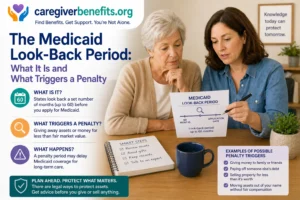
Medicaid financial rules can be strict for married couples. Some people may need to ask about Medicaid spend-down, spousal impoverishment rules, or a look-back period. Do not give away money, retitle property, or pay yourself from your spouse’s funds without advice from the right office or a qualified professional.
Helpful background: Medicaid spend-down and Medicaid look-back period.
VA options for spouses
If your spouse is a Veteran, check VA routes even if Medicaid says no. VA rules are separate from Illinois Medicaid rules.
PCAFC
PCAFC is the VA family caregiver program that may pay a monthly stipend to an approved primary family caregiver. A spouse can meet the caregiver relationship rule. The caregiver must be at least 18.
The Veteran must meet VA rules. VA lists requirements that include VA health care enrollment, a VA disability rating of 70% or higher, and the need for at least 6 months of continuous in-person personal care services.
The Veteran and caregiver apply together. VA uses VA Form 10-10CG. If approved, the primary caregiver may get a monthly stipend. Secondary caregivers may get support, but the monthly stipend is for the primary caregiver.
Veteran Directed Care
Veteran Directed Care is for Veterans who need help with activities of daily living, such as bathing, dressing, using the bathroom, moving, eating, or fixing meals. VA says the Veteran or representative gets help making a spending plan and hiring workers, which may include a family member or neighbor.
This service is not offered everywhere. Ask the VA social worker whether Veteran Directed Care is available through the Veteran’s VA medical center and whether a spouse can be hired under the local program rules.
VA Aid and Attendance is different
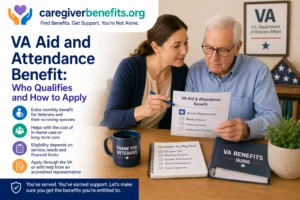
VA Aid and Attendance is not a paycheck to the spouse caregiver. It may increase a VA pension for an eligible Veteran or surviving spouse who needs help with daily activities. The household may then use the added money for care costs, but the benefit belongs to the person who qualifies.
Learn more here: VA Aid and Attendance.
What to say to VA
“I am the spouse caregiver for a Veteran. I need to ask about PCAFC, Veteran Directed Care, respite, and home care options. Can you connect me with the caregiver support team or the Veteran’s social worker?”
You can call the VA Caregiver Support Line at 1-855-260-3274.
Paid family leave options
Illinois does not have a broad state paid family and medical leave benefit like some other states. But Illinois workers may still have paid or protected time off options.
Illinois Paid Leave for All Workers Act
The Illinois Department of Labor says this law lets covered workers earn up to 40 hours of paid leave each year. Workers can use it for any reason, so a spouse caregiver may be able to use it for care tasks, appointments, or a care crisis.
This is time off from your job. It is not a caregiver wage program.
Illinois Employee Sick Leave Act
If your employer already provides personal sick leave, Illinois law may require the employer to let you use at least part of that sick leave to care for a covered family member. A spouse is a covered family member.
This law does not force every employer to create extra sick leave. It lets you use part of existing sick leave for family care when the law applies.
Federal FMLA
The federal Family and Medical Leave Act can give eligible workers unpaid, job-protected leave to care for a spouse with a serious health condition. It may also allow military caregiver leave in some cases.
Ask your employer for FMLA paperwork if you need longer time off. If you think your FMLA rights were denied, contact the U.S. Department of Labor Wage and Hour Division.
Also check city and county rules if you work in Chicago or Cook County. Local paid leave rules may be different.
What to ask before applying
Before you fill out forms or quit work, ask direct questions. Write down the date, the office, the person’s name, and what they said.
Ask about the care plan
- What program is my spouse being screened for?
- Will there be a Determination of Need or other home assessment?
- Which tasks can be paid tasks?
- How many hours are being approved?
- Does the plan show why care from a spouse is needed?
Ask about spouse worker rules
- Can a spouse be paid in this program?
- Is the spouse treated as an LRI?
- Does the care have to be extraordinary?
- Can the spouse be the worker and representative, or must those be different people?
- Does the spouse need background checks, training, IMPACT enrollment, EVV, or agency hiring?
Ask about payment
- Who is the employer?
- Is payment through an agency, fiscal agent, or state payroll?
- When can the spouse start work?
- What happens if care starts before approval?
- Will taxes be withheld?
Documents to gather
- Photo ID for your spouse and caregiver
- Social Security numbers, if available and required
- Medicaid card, Medicare card, and managed care plan card
- Proof of Illinois address
- Proof of income and bank accounts, if applying for Medicaid
- Doctor notes, diagnosis list, medication list, and hospital discharge papers
- A written list of daily care tasks, such as bathing, dressing, transfers, meals, toileting, safety checks, and night help
- Power of attorney, guardianship, representative payee, or approved representative forms, if used
- Veteran DD214, VA rating letter, VA health care information, and VA provider contacts, if applying through VA
More planning help: caregiver checklists and care cost calculator.
If the answer is no
A first “no” may mean many things. It may mean the wrong program. It may mean the spouse cannot be paid under that route. It may mean the care plan does not yet show enough need. It may mean the agency does not hire family, even though another provider might.
Step 1: Ask what rule blocks payment
Say: “Can you tell me the program rule or policy that says a spouse cannot be paid in this case? Is this a Medicaid rule, an agency hiring rule, a managed care plan rule, or a care plan decision?”
Step 2: Ask about the current LRI policy
If the person is in the Elderly Waiver, Persons with Disabilities Waiver, Brain Injury Waiver, or HIV/AIDS Waiver, ask whether the current Illinois LRI guidance applies. Ask whether the care can be reviewed as extraordinary care.
Step 3: Ask for other worker options
If the spouse cannot be paid, ask whether another relative, friend, neighbor, agency home care aide, homemaker service, adult day service, or respite service can be added. You can also read about respite care for caregivers.
Step 4: Ask how to appeal
Ask for the denial in writing. Ask for appeal rights and deadlines. HFS says ABE can be used to manage benefits and appeals. DHS HSP policy pages also refer customers to the Bureau of Administrative Hearings or MCO appeal steps for some service plan disputes.
Short appeal script
“I disagree with the decision that denies or limits in-home care or spouse caregiver payment. Please send the denial in writing with the rule used, appeal deadline, and where to file. I also want the care plan reviewed for the daily tasks my spouse needs to stay safely at home.”
Taxes and household money
If a spouse is paid, ask who handles payroll, tax withholding, W-2 or 1099 forms, workers’ compensation, and time records. Medicaid, VA, and agency payment systems can treat caregiver payments in different ways.
Do not guess on taxes. Start here for general background: caregiver tax deductions. For tax questions, talk with a qualified tax professional.
FAQ
Can Illinois Medicaid pay me to care for my spouse?
Sometimes. Illinois has routes that may allow spouse payment, but only when the program allows it and the care is approved. Ask about Community Care Program in-home services, the Elderly Waiver LRI rule, and DHS Home Services Program LRI rules.
Can I be both the paid spouse caregiver and the representative?
Often no, at least in LRI cases. Illinois Elderly Waiver guidance says an approved paid LRI cannot also serve as the authorized representative or sign required MCO documents. HFS guidance for some DRS waivers says someone other than the LRI must sign the LRI timesheet and annual service plan.
Can my spouse be paid if we are not on Medicaid?
Maybe through VA if your spouse is an eligible Veteran. Otherwise, most spouse caregiver payment routes need Medicaid, VA, long-term care insurance, or private pay. Medicare does not pay for most long-term personal care at home.
Does Illinois have paid family leave for spouse care?
Illinois has paid leave that can be used for any reason for many workers, and it has sick leave rights when an employer already provides sick leave. It does not have a broad state paid family leave insurance program that replaces wages for long-term spouse care.
What if the agency says it does not hire spouses?
Ask if that is the agency’s own hiring policy or a program rule. IDoA says not all in-home service providers hire family members. Ask the Care Coordination Unit if another provider in your area hires spouse caregivers.
Official sources used
- Illinois Department on Aging – Community Care Program
- Illinois Department on Aging – In-Home Service and hiring a family member or friend
- Illinois HFS – Persons who are Elderly Waiver
- Illinois HFS – Elderly Waiver LRI guidance
- Illinois DHS – Home Services Program
- Illinois DHS-DRS – Home Services Program hotline and updates
- Illinois HFS – Persons with Disabilities Waiver
- Illinois HFS – Persons with Brain Injury Waiver
- Illinois HFS – DRS waiver LRI guidance
- Illinois DHS – HSP Customer Compliance
- Illinois HFS – Managed Care Programs
- Illinois HFS – ABE Benefits and appeals
- Illinois HFS – Applying for Medicaid
- Illinois DHS – Home-Based Services Program overview
- Illinois DHS – Consumer Handbook for Home-Based Services
- Illinois Department of Labor – Paid Leave for All Workers Act
- Illinois Department of Labor – Employee Sick Leave Act
- Illinois Department of Labor – Employee Sick Leave Act FAQs
- U.S. Department of Labor – FMLA information for family caregivers
- VA – PCAFC eligibility and application
- VA – Veteran Directed Care
- VA – National Caregiver Support Line
- Medicare.gov – Long-term care coverage
About this guide
This guide was written for Illinois families trying to find real caregiver payment and leave options. It focuses on official state and federal sources, but local offices and managed care plans may apply rules to your case.
This is general information, not legal, tax, medical, or financial advice. For legal or tax questions, talk with a qualified professional in your state.