Florida caregiver leave and pay
Last checked: May 18, 2026
If you need time away from work to care for a parent, spouse, adult child, or other loved one in Florida, start with one hard fact: Florida does not have a broad state paid family leave program for private workers.
That does not mean you have no options. You may still have unpaid job-protected leave under the federal Family and Medical Leave Act, called FMLA. Some Florida state career service employees have unpaid state family medical leave rights and may be able to use accrued leave. If you need money or care help, also check employer benefits, Florida Medicaid long-term care, VA caregiver help, or respite care.
Quick answer
Florida does not have a broad state paid family leave program that pays private workers to take time off to care for a sick or disabled family member. Some workers may qualify for unpaid job-protected leave under the federal Family and Medical Leave Act, called FMLA. Some Florida state career service employees have unpaid state family medical leave rights and may be able to use accrued leave. If you need money or care help, also check employer benefits, Medicaid long-term care, VA caregiver benefits, and respite programs.
Florida warning
Rules can change. Counties, managed care plans, waiver contractors, employers, and agencies may use different names for the same kind of help. Confirm each rule with your employer, the Florida agency, the managed care plan, or the official program office before you quit a job, stop working, spend money, or count on payment.
Main programs and routes
| Route | Who it may help | Pay or time off | Where to start |
|---|---|---|---|
| Florida statewide paid family leave | Private workers needing paid time off for caregiving | No broad state program found | Do not wait for a Florida state paid leave form. Check FMLA and employer benefits. |
| Federal FMLA | Eligible workers at covered employers who need time to care for a spouse, child, or parent with a serious health condition | Up to 12 workweeks of unpaid job-protected leave in many cases; up to 26 workweeks for some military caregiver leave | Ask HR for FMLA eligibility and the family member medical certification form. |
| Florida career service employee leave | Some Florida state career service employees | Unpaid leave up to 6 months for parental or family medical leave; accrued annual, sick, or family sick leave may apply under state rules and policy | Ask your agency HR office about Florida Statutes section 110.221 and whether FMLA also applies. |
| Employer paid leave or paid family leave insurance | Workers whose employer offers paid caregiver leave, PTO, sick leave, short-term disability, leave bank, or a paid family leave insurance policy | Depends on the employer and policy | Ask HR for the plan document, policy, claim form, waiting period, and whether it runs with FMLA. |
| Florida Medicaid long-term care | People who may need nursing-home level care but want services at home or in the community | Not paid family leave. It may cover home and community-based services, adult day health care, or other care supports if eligible. | Call the Elder Helpline/ADRC. Apply for Medicaid through DCF/MyACCESS if needed. |
| VA caregiver and pension options | Veterans and survivors who meet VA rules | May include caregiver support, respite, or VA pension add-ons such as Aid and Attendance if eligible | Contact the local VA Caregiver Support Team or apply through VA.gov. |
| Respite and local caregiver programs | Family caregivers who need a break or help keeping someone safe at home | Often limited. May not pay the caregiver, but can reduce unpaid hours. | Call the ADRC, Area Agency on Aging, VA, Medicaid plan, or local disability agency. |
Does Florida have paid family leave for caregivers?
No broad Florida paid family leave program was found for private workers as of the last check date above.
This matters because some states run a paid family and medical leave program. Those programs may replace part of a worker’s wages while they care for a covered family member. Florida is different. A Florida caregiver usually must look to federal FMLA, employer benefits, state employee leave rules, Medicaid care services, VA programs, or local caregiver support.
Florida does have laws about paid family leave insurance. But that is not the same as a state-run benefit that every worker can claim. It is a type of insurance that may be issued to and purchased by an employer. If your employer has this kind of policy, your rights, pay, waiting period, forms, and covered family members depend on that policy.
Florida also has a state employee leave law for certain career service employees. It allows unpaid parental or family medical leave up to 6 months and says eligible employees may use certain accrued leave credits. This does not create a broad paid family leave program for all Florida workers.
Who qualifies
There is no one Florida paid family leave application for caregivers. Who qualifies depends on the route you use.
For FMLA
You may qualify if all of these are true:
- You work for a covered employer.
- You have worked for that employer for at least 12 months.
- You have at least 1,250 hours of service in the 12 months before leave starts.
- You work at a place where the employer has at least 50 employees within 75 miles.
- You need leave for a covered reason, such as caring for a spouse, child, or parent with a serious health condition.
FMLA does not usually cover leave to care for a parent-in-law, sibling, grandparent, aunt, uncle, or friend. Your employer may have a broader policy, so ask. For an adult child, FMLA rules can be more limited. Ask HR and the doctor to confirm whether the adult child meets the FMLA rule for a child who is incapable of self-care because of a disability.
For Florida state career service employee leave
Florida’s state employee law uses the word “family” to mean a child, parent, or spouse. It defines family medical leave as leave for a serious family illness that meets the law’s standard, including certain severe conditions or a mental or physical condition that requires constant in-home care.
If you work for the State of Florida, do not assume you are covered just because you are a public employee. Ask your agency HR office if you are in career service, whether section 110.221 applies, whether FMLA applies, and whether you can use accrued leave.
For employer paid leave or insurance
Your employer may have paid sick leave, PTO, short-term disability, donated leave, caregiver leave, or paid family leave insurance. The policy may define family more broadly than FMLA. It may also require a doctor’s note, a claim form, a waiting period, or proof that you are missing work to provide care.
Ask for the written policy. Do not rely on a hallway answer.
For Medicaid, VA, or respite help
These are not paid leave from your job. They may help pay for care, reduce your care hours, or support the person who needs help. Rules depend on the person’s age, income, assets, disability, level of care, veteran status, and program openings.
How much pay and how much time
For a Florida private worker, the state paid family leave amount is usually simple: there is no broad state wage-replacement benefit to apply for.
| Option | Pay | Time | Job protection |
|---|---|---|---|
| Florida broad paid family leave | No broad state payment found | No broad state paid leave bank found | No broad state paid leave job protection found |
| FMLA | Unpaid, unless you use paid leave at the same time or your employer pays you | Up to 12 workweeks in a 12-month period for many family caregiving cases | Yes, if you and the employer meet FMLA rules |
| FMLA military caregiver leave | Unpaid, unless paid leave or employer pay applies | Up to 26 workweeks in a single 12-month period for a covered servicemember or covered veteran | Yes, if FMLA rules are met |
| Florida state career service leave | Unpaid leave, but accrued annual, sick, or family sick leave may be used if the rules and policy allow it | Up to 6 months under the state law for covered career service employees | State law includes return-to-job protections for covered employees |
| Employer paid leave insurance or policy | Depends on the policy | Depends on the policy; Florida insurance law requires policy details to state the length, waiting period, and payment terms | Depends on FMLA, state law, employer policy, and the facts |
| Medicaid, VA, or respite | Not a paycheck replacement for taking leave from work | Service hours or support vary by program | No job protection by itself |
If you need income during leave, ask HR these exact questions:
- Can I use sick leave, PTO, vacation, personal leave, or a leave bank while I am on FMLA?
- Does the company have paid family leave insurance?
- Does the company have a caregiver leave policy that covers parents, spouses, adult children, or other family?
- Will paid leave and FMLA run at the same time?
- What forms and deadlines apply?
How to apply
Because Florida does not have a broad state paid family leave claim system, the right application path depends on what you are asking for.
Step 1: Ask your employer for FMLA and paid leave review
Start with HR, benefits, or your supervisor if there is no HR office. You do not need to use legal words. You do need to give enough information so the employer knows the request may be for FMLA.
Say that you need time away from work to care for a family member with a serious health condition. Ask for FMLA eligibility, the rights and responsibilities notice, and any paid leave or insurance claim forms.
Step 2: Give notice as early as you can
If the need for leave is foreseeable, such as planned surgery or treatment, FMLA generally requires 30 days advance notice. If the need is sudden, tell your employer as soon as practical. Follow the normal call-out rule at work if you can.
Step 3: Get the medical certification done
Your employer may require medical certification for FMLA. For leave to care for a family member, the optional federal form is WH-380-F. Your employer may use its own form if it asks for only the allowed information.
If your employer asks for certification, you generally have at least 15 calendar days to return it. Ask the doctor’s office to explain the care needed, the likely schedule, and whether leave must be full-time, part-time, or on short blocks of time.
Step 4: Ask how paid time will be handled
FMLA is unpaid. But paid sick leave, PTO, vacation, employer caregiver leave, or a paid family leave insurance policy may run at the same time. Ask for the answer in writing so you know whether you will be paid and whether your job is protected.
Step 5: Keep copies
Keep a folder with your request, HR emails, doctor forms, approval or denial letters, pay records, and notes from calls. Write down the date, time, name, and office for each call.
How it works with FMLA
FMLA is the main job-protected leave route for many Florida caregivers. It is federal law, not a Florida paid leave program.
FMLA may let an eligible worker take unpaid leave to care for a spouse, child, or parent with a serious health condition. It can also apply to some military caregiving leave. If FMLA applies, the employer must keep group health benefits under the same terms and must return the worker to the same or a nearly identical job when leave ends.
FMLA leave can be taken all at once. It can also be taken in short blocks or on a reduced schedule when medically needed for a family member’s serious health condition. This can help if you need to take a parent to dialysis twice a week, stay home after surgery, or attend treatment visits.
FMLA does not pay you by itself. A Florida paid leave insurance policy, employer sick leave, PTO, or vacation may pay you while the same time also counts as FMLA. Your employer may require you to use paid leave during FMLA, or you may be able to choose to use it, depending on the policy and the law.
If you are also covered by Florida state career service leave, ask HR if the state leave and FMLA will run at the same time. Also ask what happens to health insurance, seniority, retirement credit, and paid leave balances.
If Florida does not have paid leave
If you were hoping for a Florida paid family leave check, you may need a backup plan. These are the next places to check.
Employer benefits
Ask about PTO, sick leave, vacation, donated leave, short-term disability, paid family leave insurance, flexible schedule, remote work, unpaid personal leave, and hardship leave. Ask for written rules, not just a verbal answer.
Florida Medicaid long-term care
Florida’s Statewide Medicaid Managed Care Long-Term Care program is run through several agencies. AHCA administers the program and enrolls eligible people in long-term care plans. DCF decides financial eligibility. The Department of Elder Affairs decides medical eligibility and level of care.
The program may cover home and community-based services for people who qualify. Services may include adult day health care and other supports that help a person remain at home or in the community. This is not paid leave from your job, but it may reduce the number of unpaid hours your family must cover.
ADRC and Area Agency on Aging
Florida’s 11 Area Agencies on Aging operate as Aging and Disability Resource Centers. They are a first call for long-term care resources, local programs, caregiver support, and screening routes. Call 1-800-963-5337 and ask for your county’s ADRC.
VA caregiver support
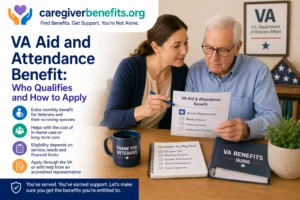
If the person you care for is a veteran, contact the VA Caregiver Support Program. Ask about caregiver support, respite, and whether the veteran may qualify for VA Aid and Attendance or Housebound benefits. Aid and Attendance can add a monthly amount to a VA pension for qualified veterans or survivors who need help with daily activities or are housebound.
Family Home Health Aide for medically fragile children
Florida has a Family Home Health Aide Program for certain medically fragile children under 21 who already qualify for Private Duty Nursing. It allows an eligible family member or guardian to be trained and employed by a licensed home health agency. This is a narrow child-focused path, not a general adult caregiver paid leave program.
Respite care
Respite means a short break from caregiving. It may come through Medicaid, the aging network, VA, disability programs, adult day care, faith groups, or local grants. It may not pay you, but it may buy back time so you can keep working.
Helpful next reads on CaregiverBenefits.org:
What to say on the phone
Call HR or benefits
“I need time off to care for my [parent/spouse/child] with a serious health condition. I am asking whether I qualify for FMLA and whether any paid leave, sick leave, PTO, leave bank, or paid family leave insurance can pay me during that time. Please send me the forms, deadlines, and policy in writing.”
Call the doctor’s office
“My employer may need a medical certification for FMLA. Can the doctor complete the form showing the condition, the dates, the care tasks I need to do, and whether I need full-time leave, reduced hours, or leave for appointments?”
Call the ADRC or Elder Helpline
“I am caring for someone in Florida who needs help at home. I need to ask about long-term care screening, Medicaid home and community-based services, caregiver support, respite, and adult day care. Which office handles this for my county?”
Call a Medicaid plan or waiver contact
“My family cannot safely cover all care hours. I need to ask what covered services may help at home, whether respite or adult day health care is available, and how to request a service review or appeal if services are denied.”
Documents to gather
Start a folder before you apply or call. These papers can save time:
- Your work schedule, job title, hire date, and HR contact.
- Recent pay stubs and leave balances, if you have them.
- Employer handbook pages on FMLA, sick leave, PTO, unpaid leave, and paid leave.
- The loved one’s diagnosis list, medication list, and doctor contact information.
- Hospital discharge papers, care plan, therapy schedule, or home health orders.
- A simple list of daily tasks you provide, such as bathing, dressing, meals, transfers, toileting, wound care reminders, supervision, transportation, or overnight safety checks.
- Dates you need off, including appointments, surgery, recovery, or regular treatment.
- Medicaid, Medicare, managed care plan, VA, or insurance cards.
- Any DCF, AHCA, Medicaid plan, VA, or employer denial letter.
- Power of attorney, health care surrogate, guardianship, or authorized representative forms, if you have them.
What to do if the first answer is no
A first “no” may mean the wrong office answered, the wrong form was used, or the person did not understand the caregiving need.
- Ask for the denial or reason in writing.
- Ask HR for the FMLA eligibility notice and the exact reason you are not eligible.
- Ask whether employer paid leave, PTO, or unpaid personal leave is available even if FMLA is not.
- If a medical certification was called incomplete, ask what is missing and by what date it must be fixed.
- If Medicaid or long-term care services are denied, read the notice and ask about a fair hearing or plan appeal deadline.
- If the person is a veteran, ask the VA Caregiver Support Team about other caregiver or respite options.
- If the person on the phone cannot help, ask: “Which office handles caregiver leave, long-term care screening, or service appeals?”
FAQ
Does Florida pay me to take family leave from work?
Florida does not have a broad state paid family leave program for private workers. Your pay may come from employer PTO, sick leave, a paid family leave insurance policy, or another employer benefit if offered.
Can I use FMLA to care for my mother or father in Florida?
Maybe. FMLA can cover leave to care for a parent with a serious health condition if you, your employer, and the reason for leave meet FMLA rules. FMLA does not cover parents-in-law under the basic rule.
Can I use FMLA to care for my spouse?
Yes, if the spouse has a serious health condition and the other FMLA rules are met. Ask HR for the family member certification process.
Can I use FMLA to care for an adult child?
Sometimes. FMLA rules for adult children are more limited. The adult child generally must be incapable of self-care because of a disability when leave starts. Ask HR to review the rule and ask the doctor to explain the need for care.
Can my employer make me use PTO during FMLA?
In many cases, paid leave can run at the same time as FMLA. The exact rule depends on the law and your employer policy. Ask HR if PTO, sick leave, or vacation will be required, allowed, or saved.
Is Medicaid caregiver pay the same as paid family leave?
No. Paid family leave replaces wages while you take time away from work. Medicaid long-term care may pay for covered care services for the person who needs help. Some programs may allow certain family caregivers to be paid in limited situations, but that is not the same as a statewide paid leave benefit.
Who should I call first in Florida?
If the issue is time off from work, call HR first. If the issue is home care, respite, or long-term care help, call the Florida Elder Helpline at 1-800-963-5337 and ask for the ADRC for your county. If the person is a veteran, call the local VA Caregiver Support Team.
Resumen en espanol
Florida no tiene un programa estatal amplio de licencia familiar pagada para cuidadores privados. Pregunte primero a recursos humanos sobre FMLA, tiempo pagado, seguro de licencia familiar pagada, PTO o licencia por enfermedad. Si la persona necesita ayuda en casa, llame al Elder Helpline al 1-800-963-5337 y pida hablar con el ADRC de su condado.
About this page
This page is for Florida family caregivers who need a practical first route for time off, pay, home care, or respite. It focuses on official sources and does not promise approval. Program names, forms, and steps can change.
Disclaimer
This is general information, not legal, tax, medical, or financial advice. For legal or tax questions, talk with a qualified professional in your state.
Official sources used
- U.S. Department of Labor Women’s Bureau: State Paid Family and Medical Leave Laws
- U.S. Department of Labor Wage and Hour Division: Family and Medical Leave Act
- U.S. Department of Labor: FMLA Forms
- U.S. Department of Labor Fact Sheet #28E: Requesting Leave under the FMLA
- U.S. Department of Labor Fact Sheet #28G: Medical Certification under the FMLA
- Florida Statutes section 110.221: Parental or family medical leave
- Florida Statutes section 624.6086: Paid family leave insurance defined
- Florida Statutes section 627.445: Paid family leave insurance
- Florida Agency for Health Care Administration: Statewide Medicaid Managed Care Long-Term Care Program
- Florida AHCA: Find Out About Long-Term Care Services
- Florida Department of Children and Families: Medicaid
- Florida DCF: Applying for Assistance
- Florida Department of Elder Affairs: Aging and Disability Resource Centers
- Florida Department of Elder Affairs: Caregiving
- Florida AHCA: Family Home Health Aide Program
- VA Caregiver Support Program
- VA Aid and Attendance benefits and Housebound allowance