New York caregiver benefits
Last checked: May 18, 2026
If you work in New York and need time away from work to care for a seriously ill family member, New York Paid Family Leave may help. It can pay part of your wages and protect your job while you care for a covered family member.
This guide explains where to start, what forms to use, what to ask for, and what to do if Paid Family Leave does not fit your situation.
Quick answer
Yes. New York has Paid Family Leave for eligible workers who need time off to care for a covered family member with a serious health condition. In 2026, the benefit can provide up to 12 weeks of job-protected paid leave at 67% of your average weekly wage, up to a weekly cap.
Paid Family Leave is not the same as Medicaid caregiver pay. If you need ongoing pay for hands-on home care, look at New York Medicaid home care routes such as CDPAP or Managed Long Term Care, not only work leave.
Main programs and routes
| Route | Who it may help | Where to start |
|---|---|---|
| New York Paid Family Leave | Workers who need time off to care for a covered family member with a serious health condition | Ask your employer for the PFL insurance carrier and the family care forms |
| FMLA | Workers who need job-protected unpaid leave and meet federal work and employer rules | Ask HR whether your leave is being counted as FMLA, PFL, or both |
| New York Medicaid CDPAP | Medicaid members who qualify for home care and want to choose their own personal assistant | Ask the Medicaid plan, local DSS/HRA, or NY Connects about CDPAP |
| Managed Long Term Care, including PACE | People who need long-term services and supports at home or in the community | Ask NY Connects, the Medicaid plan, or the local social services office about MLTC screening |
| VA caregiver and pension routes | Veterans, survivors, and caregivers who may qualify for VA support | Call the VA Caregiver Support Line or ask about Aid and Attendance |
| Respite and aging services | Caregivers who need a safe break, adult day care, in-home respite, or local help | Call NY Connects and ask for your local Office for the Aging |
Does New York have paid family leave for caregivers?
Yes. New York Paid Family Leave can cover time off to care for a close family member with a serious health condition.
A serious health condition means an illness, injury, impairment, or physical or mental condition that involves inpatient care or continuing treatment or supervision by a health care provider.
This leave is for the worker who needs time away from work. It is not a long-term home care payment program. It does not pay you forever to be a caregiver. It helps during a covered leave period from your job.
New York says Paid Family Leave also includes job protection, continued health insurance on the same terms, and protection from discrimination or retaliation.
Who qualifies
Most employees who work in New York State for private employers are covered. Public employees may be covered if their public employer has opted in or if the benefit was negotiated through a union agreement.
For private workers, the basic time-worked rules are:
- 20 or more hours per week: you are usually eligible after 26 straight weeks with that employer.
- Less than 20 hours per week: you are usually eligible after working 175 days for that employer. The days do not need to be in a row.
Citizenship or immigration status is not a factor in New York Paid Family Leave eligibility.
Independent contractors are not covered as employees. Self-employed people can choose to buy coverage, but this must be set up before they need leave. If you are not sure whether you are an employee or contractor, ask the insurance carrier for a written decision.
Which family members count?
For family care leave, New York lists these covered family members:
- spouse
- domestic partner
- child, stepchild, or a child for whom you have legal custody
- parent or stepparent
- parent-in-law
- grandparent
- grandchild
- sibling
The family member does not have to live in New York. New York also recognizes some parent-like relationships. If the relationship is not simple on paper, the insurer may ask for a statement or other proof.
How much pay and how much time
For 2026, eligible New York workers can take up to 12 weeks of Paid Family Leave. The leave can be taken all at once or in full-day blocks.
The wage benefit is 67% of your average weekly wage, up to 67% of the New York State Average Weekly Wage. For 2026, New York lists the maximum weekly benefit as $1,228.53.
Your average weekly wage is usually based on your wages from the eight weeks before your leave starts. If your wages change from week to week, ask the carrier how it calculated your amount.
Paid Family Leave is funded through employee payroll deductions. For 2026, New York lists the employee contribution rate as 0.432% of gross wages per pay period, with a yearly cap.
Paid Family Leave benefits may be taxable. Taxes are not always withheld automatically. Ask the carrier how tax withholding works and talk with a tax professional if you need tax advice.
How to apply
Step 1: Tell your employer
If the leave is foreseeable, give your employer at least 30 days of notice. If the need is sudden, tell your employer as soon as you can.
Keep a copy of your notice. Email is helpful because it creates a date record.
Step 2: Get the right forms
For leave to care for a family member with a serious health condition, New York lists this form package:
- Form PFL-1: Request for Paid Family Leave
- Form PFL-3: Release of Personal Health Information Under the Paid Family Leave Law
- Form PFL-4: Health Care Provider Certification for Care of Family Member with Serious Health Condition
You can ask your employer, the insurance carrier, or the New York Paid Family Leave website for the forms.
Step 3: Give Form PFL-1 to your employer
You fill out your part of Form PFL-1. Then give it to your employer for the employer section. New York says the employer must return it within three business days.
If the employer does not return it, you do not have to stop. Submit your part of Form PFL-1 with the rest of your claim package to the insurance carrier.
Step 4: Get the medical certification
The care receiver signs Form PFL-3 and gives it to the health care provider. Do not send Form PFL-3 to the insurance carrier.
You and the health care provider complete Form PFL-4. Ask the provider to return it to you as soon as possible.
Step 5: Send the claim to the insurance carrier
Send Form PFL-1, Form PFL-4, and any required documents to your employer’s Paid Family Leave insurance carrier. New York says you must submit the completed package within 30 days after the start of leave to avoid losing benefits.
The carrier usually must pay or deny the claim within 18 calendar days after it receives the completed request or after your first day of leave, whichever is later.
What to say on the phone
Call HR or your employer
“I need to request New York Paid Family Leave to care for a family member with a serious health condition. Please tell me the name and contact information for our Paid Family Leave insurance carrier. I also need the family care form package: PFL-1, PFL-3, and PFL-4.”
Call the health care provider
“I am applying for New York Paid Family Leave to care for my family member. The insurer needs the Health Care Provider Certification, Form PFL-4. Can the provider complete it and return it to me by [date]?”
Call NY Connects if leave will not solve the care problem
“I am caring for someone at home in New York. I need help with home care, Medicaid long-term care, CDPAP, respite, or adult day services. Can you connect me with the right local office and tell me what to ask for?”
Documents to gather
- Your employer’s name, address, and HR contact
- The Paid Family Leave insurance carrier name and claim address or fax number
- Your work schedule and planned leave dates
- Your last eight weeks of pay records, if you have them
- The family member’s full legal name and relationship to you
- The health care provider’s name and contact information
- Form PFL-1, Form PFL-3, and Form PFL-4
- Any proof of family relationship if the carrier asks for it
- Copies of all forms before you send them
- Proof that you sent the claim, such as fax confirmation, upload receipt, or certified mail receipt
How it works with FMLA
FMLA means the federal Family and Medical Leave Act. It can give eligible workers job-protected unpaid leave for certain family and medical reasons.
New York Paid Family Leave and FMLA are different. PFL is paid. FMLA is unpaid unless another paid benefit or paid time off applies. PFL can cover more family relationships than FMLA, such as siblings, grandparents, grandchildren, and parents-in-law.
If your leave qualifies under both laws, and your employer is covered under both laws, your employer may require PFL and FMLA to run at the same time. Your employer must tell you if it is counting the leave under both laws.
Ask HR this question in writing:
“Please confirm whether my leave will be counted as New York Paid Family Leave, FMLA, or both. Please also send me any forms or notices I must complete.”
Other caregiver pay and support routes in New York
Paid Family Leave is often the first work-leave route. But it may not cover the whole problem. If your family needs ongoing care at home, check these routes too.
New York Medicaid and CDPAP
CDPAP stands for Consumer Directed Personal Assistance Program. It is a New York Medicaid program for Medicaid members who qualify for home care and want to choose and direct their own personal assistant. New York says the personal assistant can include a friend or family member, but not the Medicaid member’s spouse, designated representative, or the parent of a CDPAP consumer under age 21.
CDPAP rules and fiscal intermediary rules have changed in recent years. Confirm the current steps with the Medicaid managed care plan, local Department of Social Services, HRA in New York City, or NY Connects before you rely on older advice.
Start with our guides: Can I get paid to be a caregiver?, caregiver pay quiz, and Medicaid HCBS waivers explained.
Managed Long Term Care and PACE
Managed Long Term Care can help people who are chronically ill or disabled and need long-term services and supports at home or in the community. Services may include home care, adult day health care, personal care, nursing, therapies, and CDPAS.
PACE is one type of long-term care option for people age 55 or older who meet program rules. Ask NY Connects or the Medicaid office whether MLTC, PACE, personal care, or CDPAP fits the care receiver.
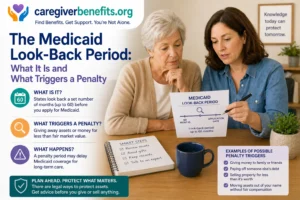
If Medicaid income or asset rules are an issue, read Medicaid spend-down and Medicaid look-back period.
VA benefits
If the person you care for is a Veteran or surviving spouse, ask about VA Aid and Attendance, VA caregiver support, respite, and local VA caregiver staff. Aid and Attendance is added to a VA pension for people who qualify and need help with daily activities or are housebound.
Start with VA Aid and Attendance.
Respite and local aging services
New York has respite routes through NYSOFA, local Offices for the Aging, and NY Connects. Respite can be in the home or outside the home, such as adult day services. Funding and waitlists can vary by county and program.
Start with respite care for caregivers, care cost calculator, phone scripts, and caregiver checklists.
If New York does not have paid leave
New York does have a state Paid Family Leave program. This section is for people who are not covered, do not meet the work history rules, are independent contractors without coverage, work for a public employer that did not opt in, or need a type of help that PFL does not pay for.
If PFL does not apply, ask about these options:
- FMLA or employer leave
- paid sick leave, vacation time, or union leave banks
- short-term disability if the worker has their own illness or injury
- New York Medicaid home care, CDPAP, MLTC, or PACE for the care receiver
- VA Aid and Attendance or VA caregiver support if the care receiver is a Veteran or survivor
- respite, adult day services, and local Office for the Aging support
- tax questions, such as whether any caregiver costs may be deductible, using caregiver tax deductions as a starting point
What to do if the first answer is no
Do not stop at a phone answer. Ask for the reason in writing.
- If HR says you are not covered, ask for the insurance carrier name anyway.
- If the carrier denies PFL, ask for the written denial and arbitration instructions.
- If a form is missing, ask exactly which form or question is missing.
- If the health care provider will not complete Form PFL-4, ask whether another licensed provider who treats the family member can complete it.
- If Medicaid or CDPAP says no, ask for the written notice, appeal rights, and the rule used.
- If a county or plan uses a different name for a program, ask what the same service is called locally.
For PFL claim disputes, New York uses arbitration through NAM. The denial notice should explain how to request it.
New York warning
Rules can change. Counties, managed care plans, waiver contractors, fiscal intermediary rules, and local offices may use different names. Always confirm the current rule with the New York Paid Family Leave insurance carrier, the Workers’ Compensation Board, NYSDOH, NY Connects, the Medicaid plan, local DSS, or HRA if you live in New York City.
Resumen en español
Nueva York sí tiene Paid Family Leave. Puede ayudar a trabajadores elegibles que necesitan tiempo libre pagado para cuidar a un familiar con una condición médica seria.
Empiece con su empleador o HR. Pida el nombre de la aseguradora de Paid Family Leave y los formularios PFL-1, PFL-3 y PFL-4. Si necesita ayuda de cuidado en casa por más tiempo, llame a NY Connects al 1-800-342-9871 y pregunte por Medicaid, CDPAP, MLTC, respiro, y la oficina local para personas mayores.
FAQ
Can I use New York Paid Family Leave to care for a parent?
Yes, if you are eligible and your parent has a serious health condition that meets the program rules. Parents and stepparents are listed family members.
Can I use it to care for a sibling?
Yes. New York lists siblings as covered family members for Paid Family Leave family care.
Can I take leave one day at a time?
Yes, but New York Paid Family Leave must be taken in full-day blocks. It is not taken by the hour.
Does Paid Family Leave pay me to be a full-time caregiver forever?
No. It is a work leave benefit. It can pay part of your wages during approved leave. For ongoing home care pay, ask about Medicaid CDPAP, personal care, MLTC, PACE, or VA routes.
Who pays the New York Paid Family Leave benefit?
In most cases, the employer’s Paid Family Leave insurance carrier pays the benefit. Some employers are self-insured.
What if my employer will not give back Form PFL-1?
New York says the employer should return it within three business days. If that does not happen, you can submit the form you completed with the rest of the package to the insurance carrier.
Official sources used
- New York State Paid Family Leave
- New York Paid Family Leave Updates for 2026
- New York Paid Family Leave Eligibility
- New York Paid Family Leave for Family Care
- New York Paid Family Leave Family Care Form Package
- New York Paid Family Leave and Other Benefits
- New York Paid Family Leave Rights and Protections
- U.S. Department of Labor FMLA Fact Sheet
- New York State Department of Health Managed Long Term Care
- New York State Department of Health CDPAP
- NY Connects
- New York State Office for the Aging Respite Services
- VA Aid and Attendance and Housebound Benefits
- VA Caregiver Support Line
About this guide
This guide was written for family caregivers looking for real benefit paths in New York. It focuses on paid leave, caregiver pay routes, home care, respite, forms, first calls, and appeal steps.
This is general information, not legal, tax, medical, or financial advice. For legal or tax questions, talk with a qualified professional in your state.